use the comparison theorem to determine whether the improper integral ∫(x² + 2x)/(√(x⁶ - 1)) dx from 2 to ∞…
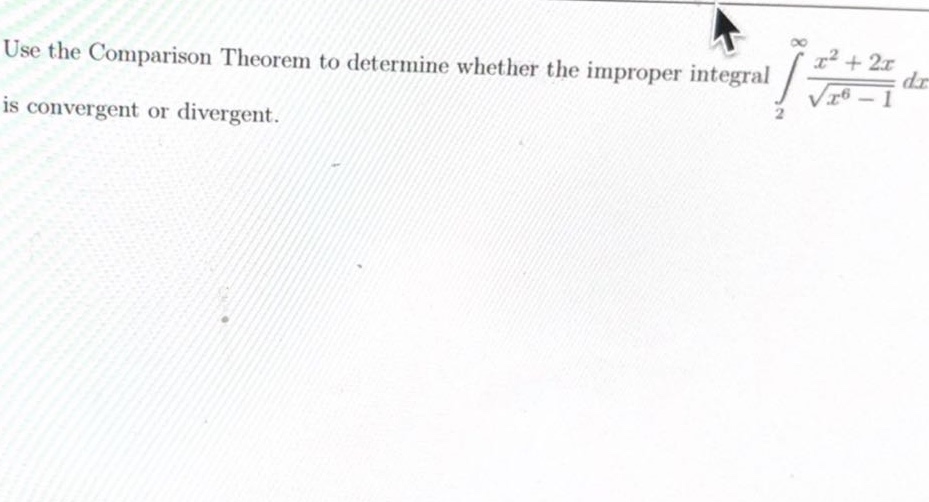
use the comparison theorem to determine whether the improper integral ∫(x² + 2x)/(√(x⁶ - 1)) dx from 2 to ∞ is convergent or divergent.
Answer
Explanation:
Step1: Find a comparable function
For (x\geq2), we have (x^{6}-1 < x^{6}), so (\frac{1}{\sqrt{x^{6}-1}}>\frac{1}{\sqrt{x^{6}}}=\frac{1}{x^{3}}). Then (\frac{x^{2}+2x}{\sqrt{x^{6}-1}}>\frac{x^{2}}{\sqrt{x^{6}-1}}>\frac{x^{2}}{x^{3}}=\frac{1}{x}).
Step2: Consider the integral of the comparison - function
We know that the improper integral (\int_{2}^{\infty}\frac{1}{x}dx=\lim_{t\rightarrow\infty}\int_{2}^{t}\frac{1}{x}dx). Using the antiderivative of (\frac{1}{x}) which is (\ln x), we have (\lim_{t\rightarrow\infty}(\ln t-\ln 2)=\infty). Since (\frac{x^{2}+2x}{\sqrt{x^{6}-1}}>\frac{1}{x}) for (x\geq2) and (\int_{2}^{\infty}\frac{1}{x}dx) diverges.
Answer:
The improper integral (\int_{2}^{\infty}\frac{x^{2}+2x}{\sqrt{x^{6}-1}}dx) diverges.