use the cosine of a sum and cosine of a difference identities to find cos(s + t) and cos(s - t). sin s =…
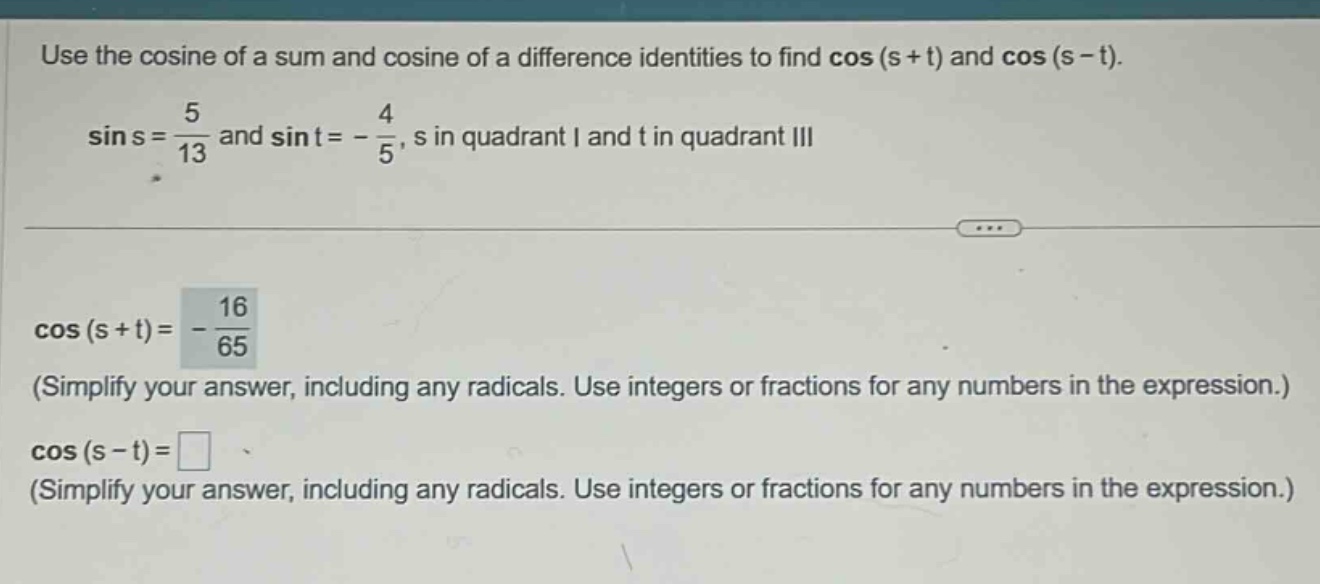
use the cosine of a sum and cosine of a difference identities to find cos(s + t) and cos(s - t). sin s = 5/13 and sin t = -4/5, s in quadrant i and t in quadrant iii cos(s + t)= -16/65 (simplify your answer, including any radicals. use integers or fractions for any numbers in the expression.) cos(s - t)= (simplify your answer, including any radicals. use integers or fractions for any numbers in the expression.)
Answer
Explanation:
Step1: Find $\cos s$
Since $\sin s=\frac{5}{13}$ and $s$ is in quadrant I, use $\sin^{2}\alpha+\cos^{2}\alpha = 1$. Then $\cos s=\sqrt{1 - \sin^{2}s}=\sqrt{1-(\frac{5}{13})^{2}}=\sqrt{\frac{169 - 25}{169}}=\frac{12}{13}$.
Step2: Find $\cos t$
Since $\sin t=-\frac{4}{5}$ and $t$ is in quadrant III, use $\sin^{2}\alpha+\cos^{2}\alpha = 1$. Then $\cos t=-\sqrt{1-\sin^{2}t}=-\sqrt{1 - (-\frac{4}{5})^{2}}=-\sqrt{\frac{25 - 16}{25}}=-\frac{3}{5}$.
Step3: Use cosine - of - a - sum formula
The cosine - of - a - sum formula is $\cos(A + B)=\cos A\cos B-\sin A\sin B$. So $\cos(s + t)=\cos s\cos t-\sin s\sin t=\frac{12}{13}\times(-\frac{3}{5})-\frac{5}{13}\times(-\frac{4}{5})=\frac{-36 + 20}{65}=-\frac{16}{65}$.
Step4: Use cosine - of - a - difference formula
The cosine - of - a - difference formula is $\cos(A - B)=\cos A\cos B+\sin A\sin B$. So $\cos(s - t)=\cos s\cos t+\sin s\sin t=\frac{12}{13}\times(-\frac{3}{5})+\frac{5}{13}\times(-\frac{4}{5})=\frac{-36-20}{65}=-\frac{56}{65}$.
Answer:
$-\frac{56}{65}$