use the definition of continuity to determine whether f is continuous at a. f(x) = { x - 14 if x ≤ 0; x² + x…
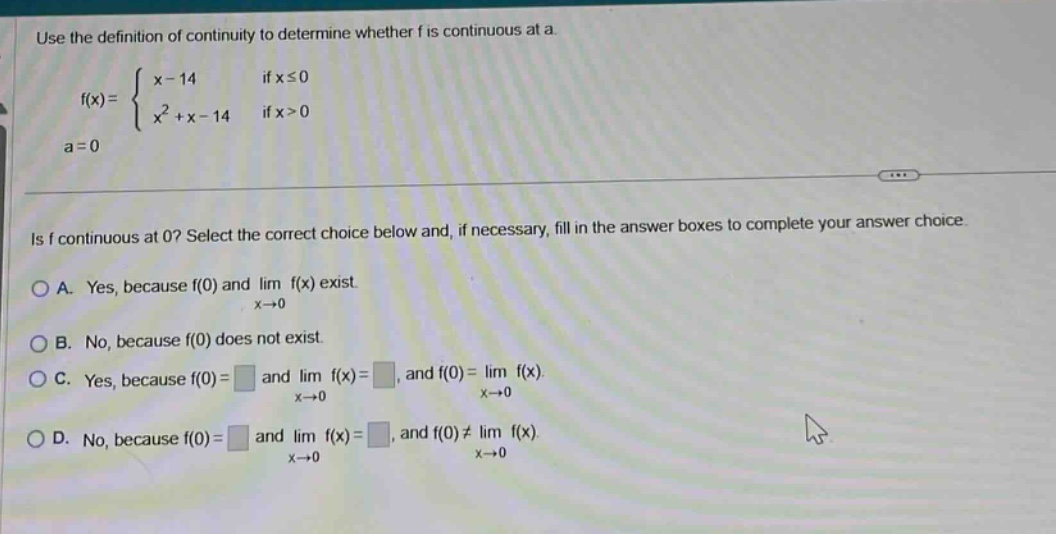
use the definition of continuity to determine whether f is continuous at a. f(x) = { x - 14 if x ≤ 0; x² + x - 14 if x > 0; a = 0. is f continuous at 0? select the correct choice below and, if necessary, fill in the answer boxes to complete your answer choice. a. yes, because f(0) and lim f(x) exist. x→0 b. no, because f(0) does not exist. c. yes, because f(0)= and lim f(x)=, and f(0)= lim f(x). x→0 x→0 d. no, because f(0)= and lim f(x)=, and f(0)≠ lim f(x). x→0 x→0
Answer
Explanation:
Step1: Find f(0)
Since (x = 0) and for (x\leq0), (f(x)=x - 14), then (f(0)=0 - 14=- 14).
Step2: Find the left - hand limit
(\lim_{x\rightarrow0^{-}}f(x)), as (x\rightarrow0^{-}) (approaching 0 from the left, (x\leq0)), (f(x)=x - 14). So (\lim_{x\rightarrow0^{-}}f(x)=\lim_{x\rightarrow0^{-}}(x - 14)=0-14=-14).
Step3: Find the right - hand limit
(\lim_{x\rightarrow0^{+}}f(x)), as (x\rightarrow0^{+}) (approaching 0 from the right, (x > 0)), (f(x)=x^{2}+x - 14). Then (\lim_{x\rightarrow0^{+}}f(x)=\lim_{x\rightarrow0^{+}}(x^{2}+x - 14)=0^{2}+0 - 14=-14).
Step4: Check the continuity condition
Since (\lim_{x\rightarrow0^{-}}f(x)=\lim_{x\rightarrow0^{+}}f(x)=f(0)=-14), the function (f(x)) is continuous at (x = 0).
Answer:
C. Yes, because (f(0)=-14) and (\lim_{x\rightarrow0}f(x)=-14), and (f(0)=\lim_{x\rightarrow0}f(x))