use the definition of continuity to determine whether f is continuous at a.\n f(x)=\begin{cases}13 - x&…
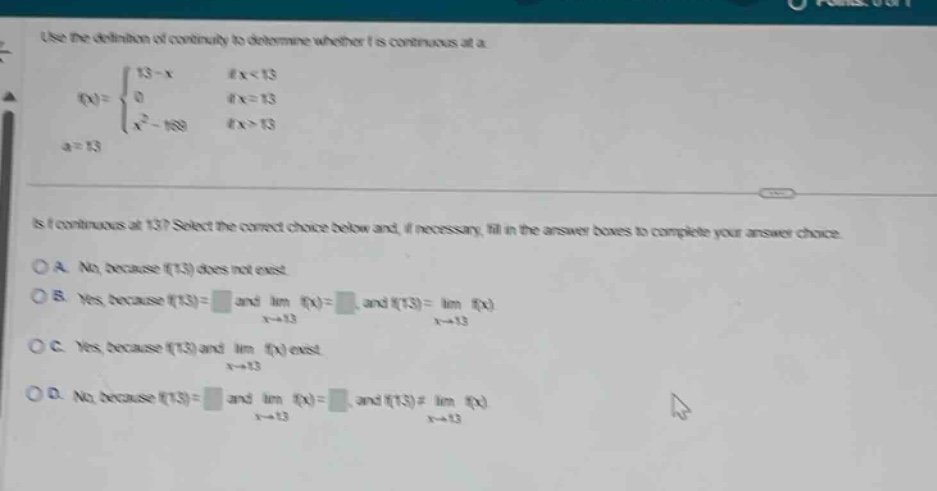
use the definition of continuity to determine whether f is continuous at a.\n f(x)=\begin{cases}13 - x& \text{if }x<13\\0& \text{if }x = 13\\x^{2}-169& \text{if }x>13end{cases},a = 13 \nis f continuous at 13? select the correct choice below and, if necessary, fill in the answer boxes to complete your answer choice.\na. no, because f(13) does not exist.\nb. yes, because f(13)= and (lim_{x\rightarrow13}f(x)=) and (f(13)=lim_{x\rightarrow13}f(x))\nc. yes, because f(13) and (lim_{x\rightarrow13}f(x)) exist.\nd. no, because f(13)= and (lim_{x\rightarrow13}f(x)=) and (f(13)\neqlim_{x\rightarrow13}f(x))
Answer
Explanation:
Step1: Check the value of the function at (x = 13)
The function is not defined at (x=13) since the piece - wise function has (x<13), (x > 13) conditions and no condition for (x = 13). So (f(13)) does not exist.
Step2: Recall the definition of continuity
A function (y = f(x)) is continuous at (x=a) if (f(a)) exists, (\lim_{x\rightarrow a}f(x)) exists and (\lim_{x\rightarrow a}f(x)=f(a)). Since (f(13)) does not exist, the function is not continuous at (x = 13).
Answer:
A. No, because (f(13)) does not exist.