(a) use the definition to find an expression for the area under the curve y = x³ from 0 to 1 as a limit. lim…
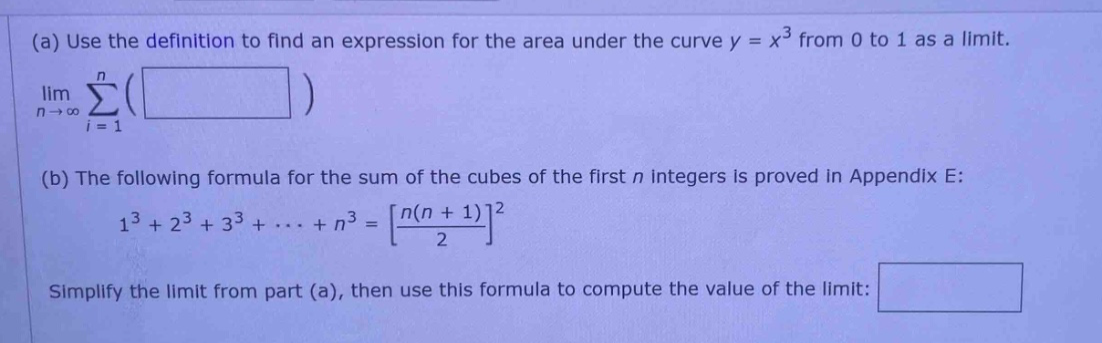
(a) use the definition to find an expression for the area under the curve y = x³ from 0 to 1 as a limit. lim σ( ) n→∞ i = 1 (b) the following formula for the sum of the cubes of the first n integers is proved in appendix e: 1³ + 2³ + 3³ + ··· + n³ = n(n + 1)/2² simplify the limit from part (a), then use this formula to compute the value of the limit:
Answer
Explanation:
Step1: Dividir el intervalo
Dividimos el intervalo $[0,1]$ en $n$ sub - intervalos de ancho $\Delta x=\frac{1 - 0}{n}=\frac{1}{n}$. Los puntos de partición son $x_i=0 + i\Delta x=\frac{i}{n}$ para $i = 0,1,\cdots,n$.
Step2: Usar la definición del área como límite
La función es $y = f(x)=x^{3}$. El área $A$ bajo la curva $y = f(x)$ en el intervalo $[a,b]=[0,1]$ se define como $A=\lim_{n\rightarrow\infty}\sum_{i = 1}^{n}f(x_i)\Delta x$. Sustituyendo $f(x_i)=(\frac{i}{n})^{3}$ y $\Delta x=\frac{1}{n}$, obtenemos $\lim_{n\rightarrow\infty}\sum_{i = 1}^{n}(\frac{i}{n})^{3}\frac{1}{n}=\lim_{n\rightarrow\infty}\frac{1}{n^{4}}\sum_{i = 1}^{n}i^{3}$.
Step3: Aplicar la fórmula del sumatorio
Sabemos que $\sum_{i = 1}^{n}i^{3}=\left[\frac{n(n + 1)}{2}\right]^{2}=\frac{n^{2}(n + 1)^{2}}{4}$. Entonces $\lim_{n\rightarrow\infty}\frac{1}{n^{4}}\sum_{i = 1}^{n}i^{3}=\lim_{n\rightarrow\infty}\frac{1}{n^{4}}\cdot\frac{n^{2}(n + 1)^{2}}{4}$.
Step4: Simplificar el límite
Expandimos $(n + 1)^{2}=n^{2}+2n + 1$. Entonces $\lim_{n\rightarrow\infty}\frac{1}{n^{4}}\cdot\frac{n^{2}(n^{2}+2n + 1)}{4}=\lim_{n\rightarrow\infty}\frac{n^{4}+2n^{3}+n^{2}}{4n^{4}}$. Dividiendo cada término en el numerador por $n^{4}$, tenemos $\lim_{n\rightarrow\infty}\left(\frac{1}{4}+\frac{2}{4n}+\frac{1}{4n^{2}}\right)$.
Step5: Calcular el límite
Como $\lim_{n\rightarrow\infty}\frac{1}{n}=0$ y $\lim_{n\rightarrow\infty}\frac{1}{n^{2}}=0$, entonces $\lim_{n\rightarrow\infty}\left(\frac{1}{4}+\frac{2}{4n}+\frac{1}{4n^{2}}\right)=\frac{1}{4}$.
Answer:
(a) $\lim_{n\rightarrow\infty}\sum_{i = 1}^{n}\left(\frac{i}{n}\right)^{3}\frac{1}{n}$ (b) $\frac{1}{4}$