use the derivative f(x)=(x - 1)(x + 2)(x + 5) to determine the local maxima and minima of f and the…
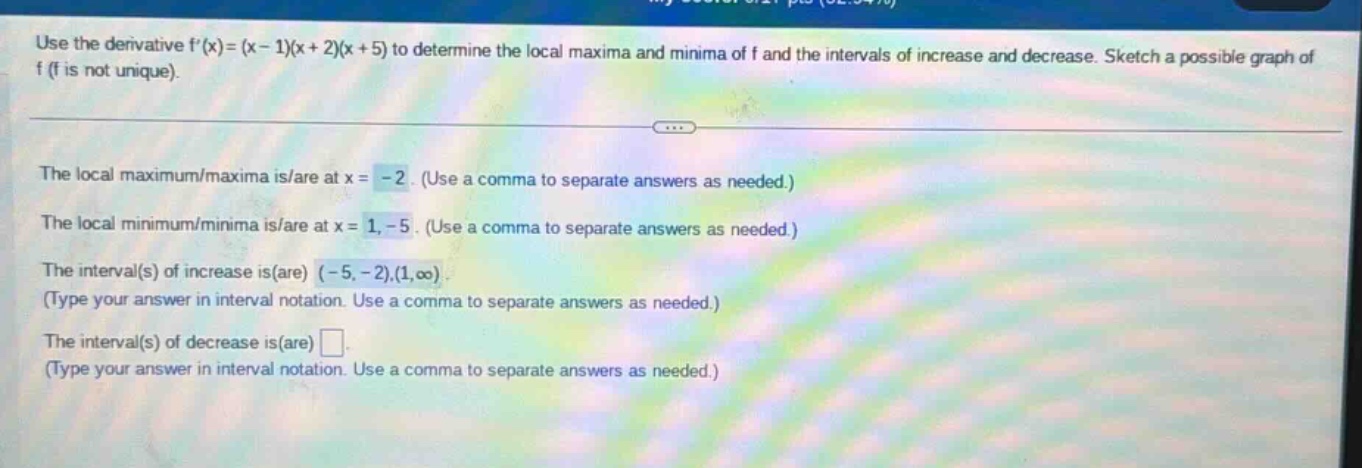
use the derivative f(x)=(x - 1)(x + 2)(x + 5) to determine the local maxima and minima of f and the intervals of increase and decrease. sketch a possible graph of f (f is not unique). the local maximum/maxima is/are at x = - 2. (use a comma to separate answers as needed.) the local minimum/minima is/are at x = 1, - 5. (use a comma to separate answers as needed.) the interval(s) of increase is(are) (- 5, - 2),(1,oo). (type your answer in interval notation. use a comma to separate answers as needed.) the interval(s) of decrease is(are) . (type your answer in interval notation. use a comma to separate answers as needed.)
Answer
Explanation:
Step1: Find critical points
Set $f^{\prime}(x)=(x - 1)(x + 2)(x + 5)=0$. The critical points are $x=-5,x=-2,x = 1$.
Step2: Test intervals
Choose test - points in the intervals $(-\infty,-5),(-5,-2),(-2,1),(1,\infty)$. For the interval $(-\infty,-5)$, let $x=-6$. Then $f^{\prime}(-6)=(-6 - 1)(-6 + 2)(-6+5)=(-7)\times(-4)\times(-1)=-28<0$, so $f(x)$ is decreasing on $(-\infty,-5)$. For the interval $(-5,-2)$, let $x=-3$. Then $f^{\prime}(-3)=(-3 - 1)(-3 + 2)(-3 + 5)=(-4)\times(-1)\times2 = 8>0$, so $f(x)$ is increasing on $(-5,-2)$. For the interval $(-2,1)$, let $x=0$. Then $f^{\prime}(0)=(0 - 1)(0 + 2)(0 + 5)=(-1)\times2\times5=-10<0$, so $f(x)$ is decreasing on $(-2,1)$. For the interval $(1,\infty)$, let $x=2$. Then $f^{\prime}(2)=(2 - 1)(2 + 2)(2 + 5)=1\times4\times7 = 28>0$, so $f(x)$ is increasing on $(1,\infty)$.
Answer:
$(-\infty,-5),(-2,1)$