use the derivative f to determine the local minima and maxima of f and the intervals of increase and dec…
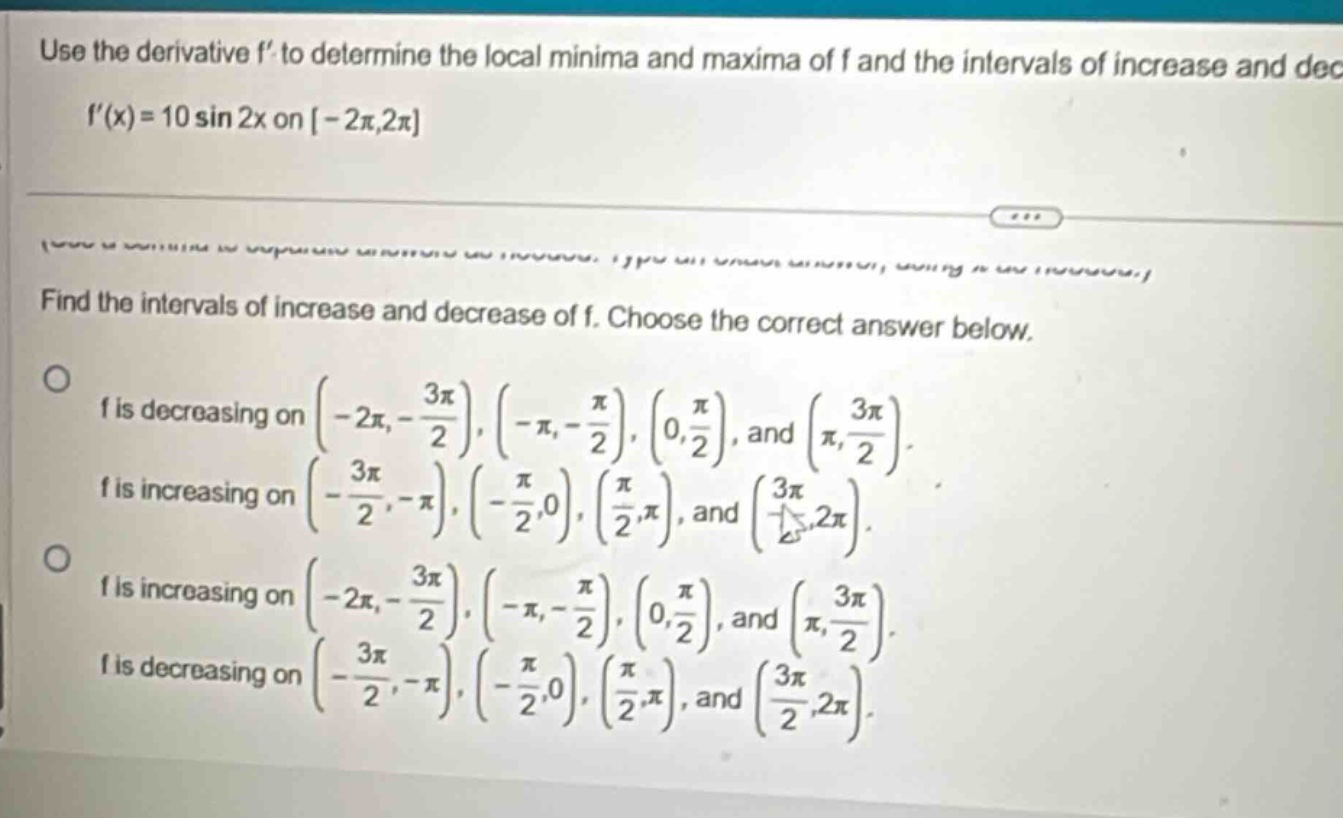
use the derivative f to determine the local minima and maxima of f and the intervals of increase and dec f(x)=10 sin 2x on -2π,2π find the intervals of increase and decrease of f. choose the correct answer below. o f is decreasing on (-2π,-3π/2),(-π,-π/2),(0,π/2), and (π,3π/2). f is increasing on (-3π/2,-π),(-π/2,0),(π/2,π), and (3π/2,2π). o f is increasing on (-2π,-3π/2),(-π,-π/2),(0,π/2), and (π,3π/2). f is decreasing on (-3π/2,-π),(-π/2,0),(π/2,π), and (3π/2,2π).
Answer
Explanation:
Step1: Recall the property of increasing - decreasing
A function $y = f(x)$ is increasing when $f'(x)>0$ and decreasing when $f'(x)<0$. Given $f'(x)=10\sin2x$, we need to find where $\sin2x>0$ and $\sin2x < 0$ on the interval $[-2\pi,2\pi]$. Let $t = 2x$. Then $t\in[-4\pi,4\pi]$. We know that $\sin t>0$ when $2k\pi<t<(2k + 1)\pi,k\in\mathbb{Z}$ and $\sin t<0$ when $(2k + 1)\pi<t<(2k + 2)\pi,k\in\mathbb{Z}$.
Step2: Solve for $x$ when $\sin2x>0$
If $\sin2x>0$, then $2k\pi<2x<(2k + 1)\pi$. Dividing by 2 gives $k\pi<x<k\pi+\frac{\pi}{2}$. For $k=- 2$: $-2\pi<x<-\frac{3\pi}{2}$; for $k = - 1$: $-\pi<x<-\frac{\pi}{2}$; for $k = 0$: $0<x<\frac{\pi}{2}$; for $k = 1$: $\pi<x<\frac{3\pi}{2}$. So $f(x)$ is increasing on $\left(-2\pi,-\frac{3\pi}{2}\right),\left(-\pi,-\frac{\pi}{2}\right),\left(0,\frac{\pi}{2}\right),\left(\pi,\frac{3\pi}{2}\right)$.
Step3: Solve for $x$ when $\sin2x<0$
If $\sin2x<0$, then $(2k + 1)\pi<2x<(2k + 2)\pi$. Dividing by 2 gives $k\pi+\frac{\pi}{2}<x<(k + 1)\pi$. For $k=-2$: $-\frac{3\pi}{2}<x<-\pi$; for $k=-1$: $-\frac{\pi}{2}<x<0$; for $k = 0$: $\frac{\pi}{2}<x<\pi$; for $k = 1$: $\frac{3\pi}{2}<x<2\pi$. So $f(x)$ is decreasing on $\left(-\frac{3\pi}{2},-\pi\right),\left(-\frac{\pi}{2},0\right),\left(\frac{\pi}{2},\pi\right),\left(\frac{3\pi}{2},2\pi\right)$.
Answer:
$f$ is increasing on $\left(-2\pi,-\frac{3\pi}{2}\right),\left(-\pi,-\frac{\pi}{2}\right),\left(0,\frac{\pi}{2}\right),\left(\pi,\frac{3\pi}{2}\right)$ and $f$ is decreasing on $\left(-\frac{3\pi}{2},-\pi\right),\left(-\frac{\pi}{2},0\right),\left(\frac{\pi}{2},\pi\right),\left(\frac{3\pi}{2},2\pi\right)$. So the second - option is correct.