use the derivative fto determine the local minima and maxima of f and the intervals of increase and…
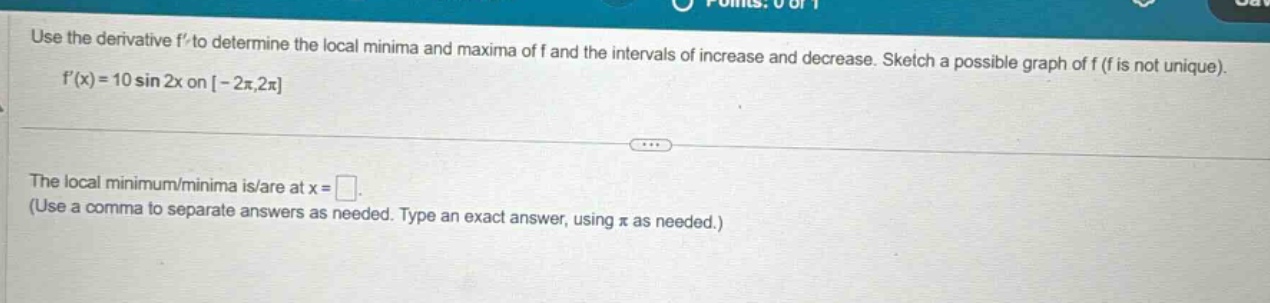
use the derivative fto determine the local minima and maxima of f and the intervals of increase and decrease. sketch a possible graph of f (f is not unique). f(x)=10 sin 2x on -2π,2π the local minimum/minima is/are at x = . (use a comma to separate answers as needed. type an exact answer, using π as needed.)
Answer
Explanation:
Step1: Find critical points
Set $f^{\prime}(x)=0$. So, $10\sin(2x) = 0$. Then $\sin(2x)=0$. We know that $\sin\theta = 0$ when $\theta = k\pi$, where $k\in\mathbb{Z}$. So, $2x=k\pi$, and $x=\frac{k\pi}{2}$. For $x\in[- 2\pi,2\pi]$, when $k=-4,-3,-2,-1,0,1,2,3,4$, $x=-2\pi,-\frac{3\pi}{2},-\pi,-\frac{\pi}{2},0,\frac{\pi}{2},\pi,\frac{3\pi}{2},2\pi$.
Step2: Determine intervals of increase and decrease
We use the test - point method. Divide the interval $[-2\pi,2\pi]$ into sub - intervals by the critical points. Consider the sub - intervals $(-2\pi,-\frac{3\pi}{2}),(-\frac{3\pi}{2},-\pi),(-\pi,-\frac{\pi}{2}),(-\frac{\pi}{2},0),(0,\frac{\pi}{2}),(\frac{\pi}{2},\pi),(\pi,\frac{3\pi}{2}),(\frac{3\pi}{2},2\pi)$. For the interval $(-2\pi,-\frac{3\pi}{2})$, let's choose a test - point $x =-\frac{7\pi}{4}$. Then $f^{\prime}(-\frac{7\pi}{4})=10\sin(-\frac{7\pi}{2}) = 10>0$, so $f(x)$ is increasing on $(-2\pi,-\frac{3\pi}{2})$. For the interval $(-\frac{3\pi}{2},-\pi)$, choose $x =-\frac{5\pi}{4}$. Then $f^{\prime}(-\frac{5\pi}{4})=10\sin(-\frac{5\pi}{2})=-10 < 0$, so $f(x)$ is decreasing on $(-\frac{3\pi}{2},-\pi)$. A local minimum occurs where the function changes from decreasing to increasing. The local minima occur at $x=-\frac{3\pi}{2},-\frac{\pi}{2},\frac{\pi}{2},\frac{3\pi}{2}$.
Answer:
$-\frac{3\pi}{2},-\frac{\pi}{2},\frac{\pi}{2},\frac{3\pi}{2}$