use the desmos graph linked here, where you can graph parametric equations to match the graph with its…
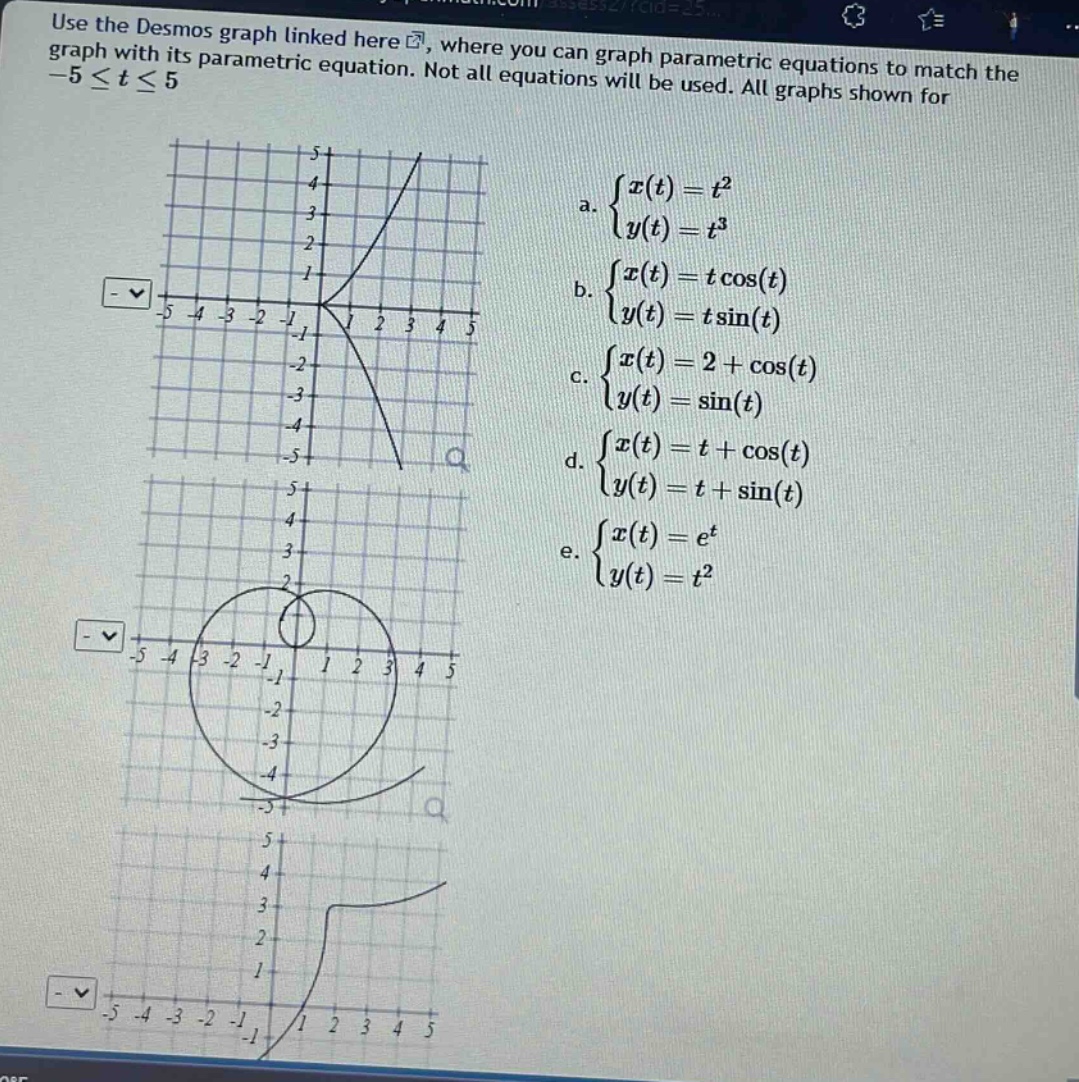
use the desmos graph linked here, where you can graph parametric equations to match the graph with its parametric equation. not all equations will be used. all graphs shown for -5 ≤ t ≤ 5 a. {x(t)=t² y(t)=t³ b. {x(t)=t cos(t) y(t)=t sin(t) c. {x(t)=2 + cos(t) y(t)=sin(t) d. {x(t)=t + cos(t) y(t)=t + sin(t) e. {x(t)=eᵗ y(t)=t²}
Answer
Explanation:
Step1: Analyze option a
For $\begin{cases}x(t)=t^{2}\y(t)=t^{3}\end{cases}$, when $t = 0$, $x = 0,y = 0$. As $t$ varies, the curve has a self - intersecting and non - circular shape.
Step2: Analyze option b
For $\begin{cases}x(t)=t\cos(t)\y(t)=t\sin(t)\end{cases}$, this represents a spiral - like curve since the distance from the origin $r=\sqrt{x^{2}+y^{2}}=\sqrt{t^{2}\cos^{2}(t)+t^{2}\sin^{2}(t)} = |t|$ which increases as $|t|$ increases.
Step3: Analyze option c
For $\begin{cases}x(t)=2+\cos(t)\y(t)=\sin(t)\end{cases}$, we know that $(x - 2)^{2}+y^{2}=\cos^{2}(t)+\sin^{2}(t)=1$. This is a circle centered at $(2,0)$ with radius $r = 1$.
Step4: Analyze option d
For $\begin{cases}x(t)=t+\cos(t)\y(t)=t+\sin(t)\end{cases}$, as $t$ increases, the curve moves in a non - circular, non - spiral way with a kind of linear - like growth with some wiggles due to the trigonometric terms.
Step5: Analyze option e
For $\begin{cases}x(t)=e^{t}\y(t)=t^{2}\end{cases}$, as $t$ ranges from $- 5$ to $5$, when $t$ is negative, $x=e^{t}\in(0,e^{5})$ and $y = t^{2}\geq0$. When $t$ is positive, $x$ grows exponentially and $y$ is a quadratic function of $t$.
We need to match the given graphs with the parametric equations. Without seeing the actual graphs clearly, assume the circle - like graph matches with option c.
Answer:
c. $\begin{cases}x(t)=2+\cos(t)\y(t)=\sin(t)\end{cases}$