use the drawing tool(s) to form the correct answer on the provided graph. the graph of function f is shown…
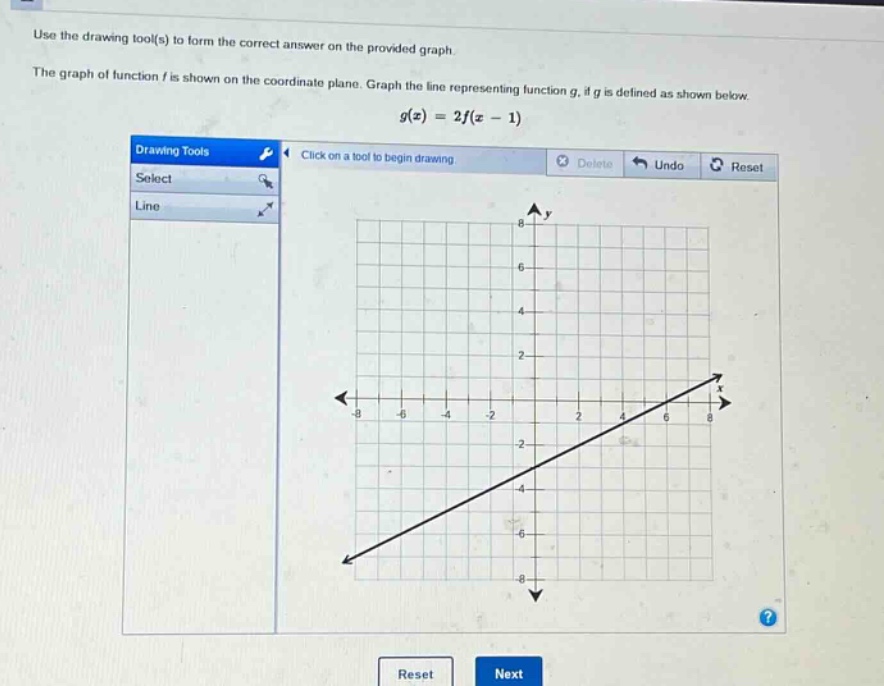
use the drawing tool(s) to form the correct answer on the provided graph. the graph of function f is shown on the coordinate plane. graph the line representing function g, if g is defined as shown below. g(x)=2f(x - 1)
Answer
Explanation:
Step1: Identify transformation rules
The transformation $g(x)=2f(x - 1)$ involves a horizontal shift and a vertical stretch. The $x-1$ inside the function $f$ shifts the graph of $f$ 1 unit to the right, and the factor of 2 outside the function $f$ vertically stretches the graph of $f$ by a factor of 2.
Step2: Find key - points on $f(x)$
Let's assume some key - points on the graph of $y = f(x)$. For example, if we have a point $(x_0,y_0)$ on $y = f(x)$.
Step3: Apply transformation to key - points
For the horizontal shift, the new $x$ - coordinate of the point on $g(x)$ is $x_1=x_0 + 1$. For the vertical stretch, the new $y$ - coordinate of the point on $g(x)$ is $y_1 = 2y_0$.
Step4: Plot new points and draw the line
After finding the new points for $g(x)$ by applying the above - mentioned transformation rules to all key - points of $f(x)$, connect these new points with a straight line to graph $g(x)$.
Since we don't have specific key - points given for $f(x)$ in a numerical form, the general process is as above. If we assume a point $(x,f(x))$ on $f(x)$, the corresponding point on $g(x)$ is $(x + 1,2f(x))$. For example, if $(0,0)$ is on $f(x)$, then $(1,0)$ is on $g(x)$; if $(2,2)$ is on $f(x)$, then $(3,4)$ is on $g(x)$. Plot these transformed points and draw the line representing $g(x)$.
Answer:
Graph the line by applying the transformation $g(x)=2f(x - 1)$ to key - points of $f(x)$ (shift right 1 unit and stretch vertically by a factor of 2) and connecting the new points.