use the dropdown menu to indicate whether each statement is true or false about the graph of the function…
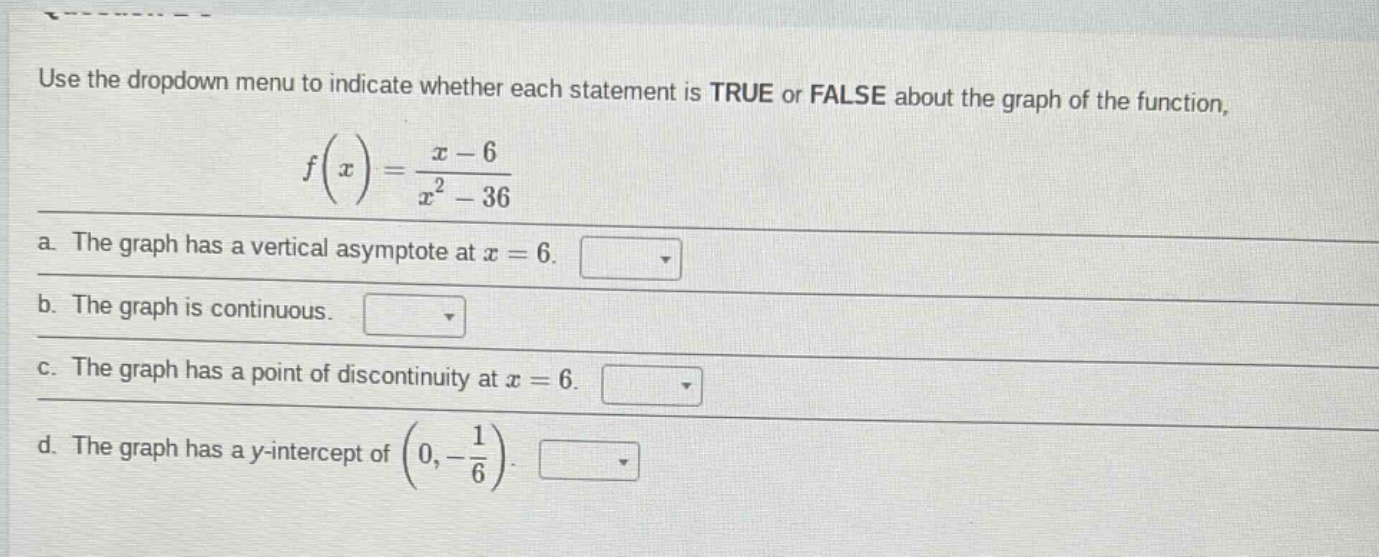
use the dropdown menu to indicate whether each statement is true or false about the graph of the function, $f(x)=\frac{x - 6}{x^{2}-36}$\na. the graph has a vertical asymptote at $x = 6$.\nb. the graph is continuous.\nc. the graph has a point of discontinuity at $x = 6$.\nd. the graph has a y - intercept of $(0,-\frac{1}{6})$.
Answer
Explanation:
Step1: Simplify the function
First, factor the denominator $x^{2}-36=(x + 6)(x - 6)$. Then $f(x)=\frac{x - 6}{(x + 6)(x - 6)}=\frac{1}{x + 6},x\neq6$.
Step2: Analyze vertical asymptote
Vertical asymptotes occur where the denominator of a rational - function is zero after simplification. For $y = \frac{1}{x + 6}$, the denominator is zero when $x=-6$. So the statement "The graph has a vertical asymptote at $x = 6$" is false.
Step3: Analyze continuity
The original function $f(x)=\frac{x - 6}{x^{2}-36}$ is not defined at $x = 6$ and $x=-6$. After simplification, $y=\frac{1}{x + 6}$ is not defined at $x=-6$. There is a removable discontinuity at $x = 6$ and an infinite discontinuity at $x=-6$. So the graph is not continuous, and the statement "The graph is continuous" is false.
Step4: Analyze point of discontinuity
Since $f(x)=\frac{x - 6}{x^{2}-36}$ is not defined at $x = 6$ (but $\lim_{x\rightarrow6}\frac{x - 6}{x^{2}-36}=\lim_{x\rightarrow6}\frac{1}{x + 6}=\frac{1}{12}$), there is a point of discontinuity at $x = 6$. So the statement "The graph has a point of discontinuity at $x = 6$" is true.
Step5: Analyze y - intercept
To find the y - intercept, set $x = 0$. Then $f(0)=\frac{0 - 6}{0^{2}-36}=\frac{-6}{-36}=\frac{1}{6}$. So the statement "The graph has a y - intercept of $(0,-\frac{1}{6})$" is false.
Answer:
a. FALSE b. FALSE c. TRUE d. FALSE