use the figure to compute the following values.\n(a) ∫a to b f(x)dx =\n(b) ∫b to c f(x)dx =
use the figure to compute the following values.\n(a) ∫a to b f(x)dx =\n(b) ∫b to c f(x)dx =
Answer
Explanation:
Step1: Recall integral - area relationship
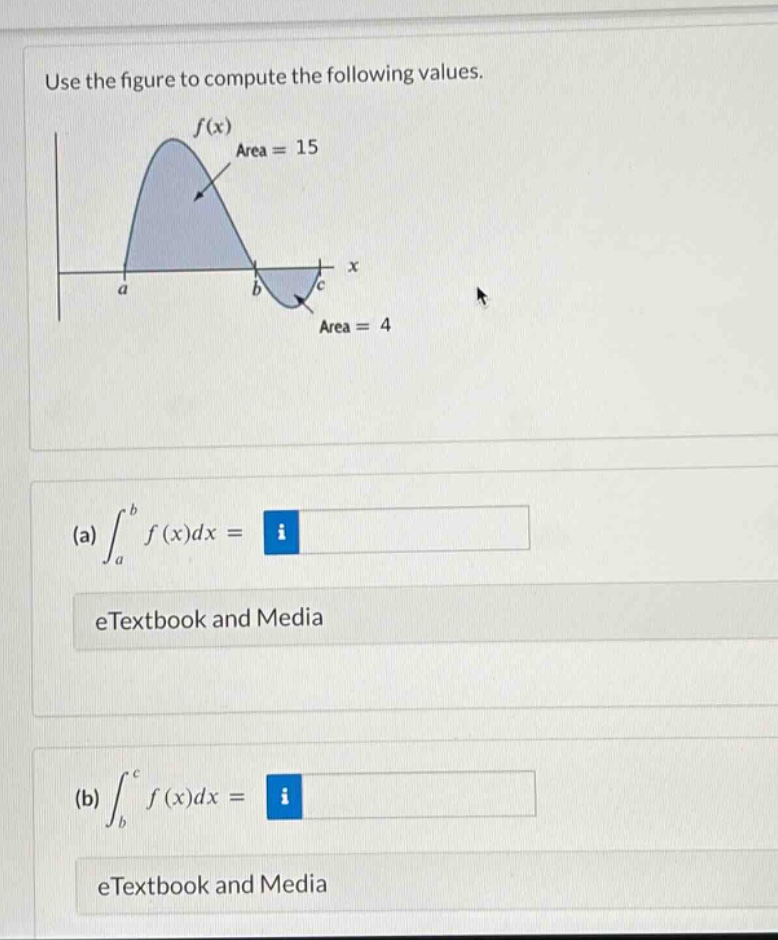
The definite integral $\int_{a}^{b}f(x)dx$ represents the net - signed area between the curve $y = f(x)$ and the $x$ - axis from $x=a$ to $x = b$. When the curve is above the $x$ - axis, the area is positive. For the interval $[a,b]$, the curve $y = f(x)$ is above the $x$ - axis and the area between the curve and the $x$ - axis from $x=a$ to $x = b$ is given as 15. So, $\int_{a}^{b}f(x)dx=15$.
Step2: Analyze the interval $[b,c]$
For the interval $[b,c]$, the curve $y = f(x)$ is below the $x$ - axis. The definite integral $\int_{b}^{c}f(x)dx$ represents the net - signed area. When the curve is below the $x$ - axis, the value of the definite integral is negative. The area between the curve and the $x$ - axis from $x = b$ to $x=c$ is 4, so $\int_{b}^{c}f(x)dx=- 4$.
Answer:
(a) 15 (b) -4