use the figure to evaluate the following function, given that g(x)=cos x. g(θ/2) g(θ/2)=□ (simplify your…
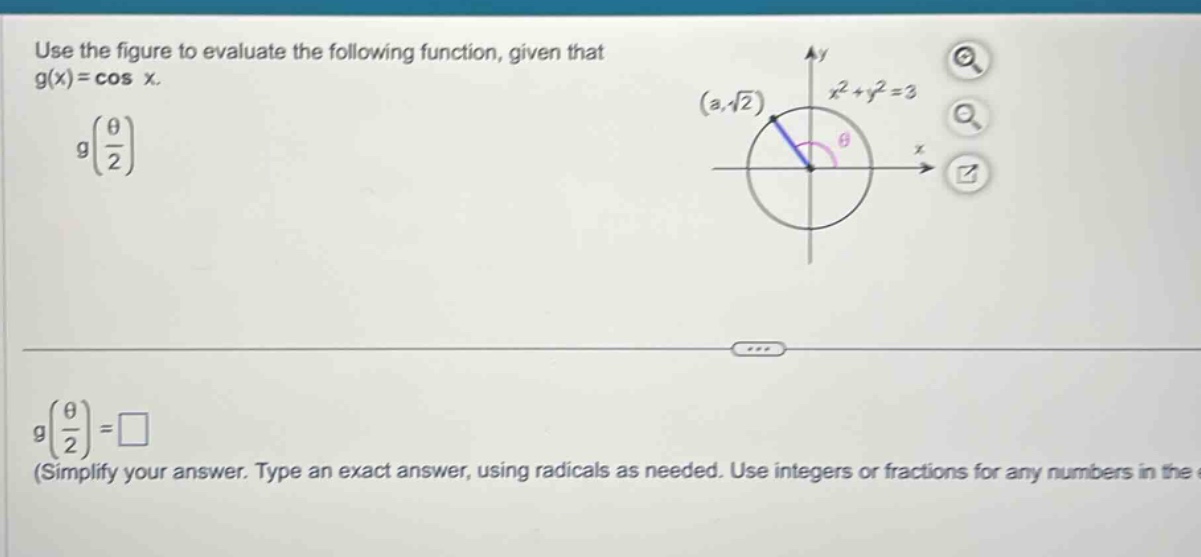
use the figure to evaluate the following function, given that g(x)=cos x. g(θ/2) g(θ/2)=□ (simplify your answer. type an exact answer, using radicals as needed. use integers or fractions for any numbers in the)
Answer
Explanation:
Step1: Find the value of (a)
Since the point ((a,\sqrt{2})) lies on the circle (x^{2}+y^{2}=3), substitute (x = a) and (y=\sqrt{2}) into the equation: (a^{2}+(\sqrt{2})^{2}=3), so (a^{2}+ 2=3), then (a^{2}=1), and (a = 1) (assuming the point is in the first - quadrant based on the context of the problem, since no other information about the quadrant is given). So, (\cos\theta=\frac{a}{\sqrt{a^{2}+(\sqrt{2})^{2}}}=\frac{1}{\sqrt{3}}) and (\sin\theta=\frac{\sqrt{2}}{\sqrt{3}}).
Step2: Use the half - angle formula for cosine
The half - angle formula for cosine is (\cos\frac{\theta}{2}=\pm\sqrt{\frac{1 + \cos\theta}{2}}). Substitute (\cos\theta=\frac{1}{\sqrt{3}}) into the formula: (\cos\frac{\theta}{2}=\pm\sqrt{\frac{1+\frac{1}{\sqrt{3}}}{2}}=\pm\sqrt{\frac{\sqrt{3}+ 1}{2\sqrt{3}}}). Since we assume the angle (\theta) is in the first - quadrant (so (\frac{\theta}{2}) is also in the first - quadrant and (\cos\frac{\theta}{2}>0)), we take the positive value. Rationalize the denominator: (\cos\frac{\theta}{2}=\sqrt{\frac{3 + \sqrt{3}}{6}}).
Answer:
(\sqrt{\frac{3+\sqrt{3}}{6}})