use finite approximation to estimate the area under the graph of f(x)=x² and above the graph of f(x)=0 from…
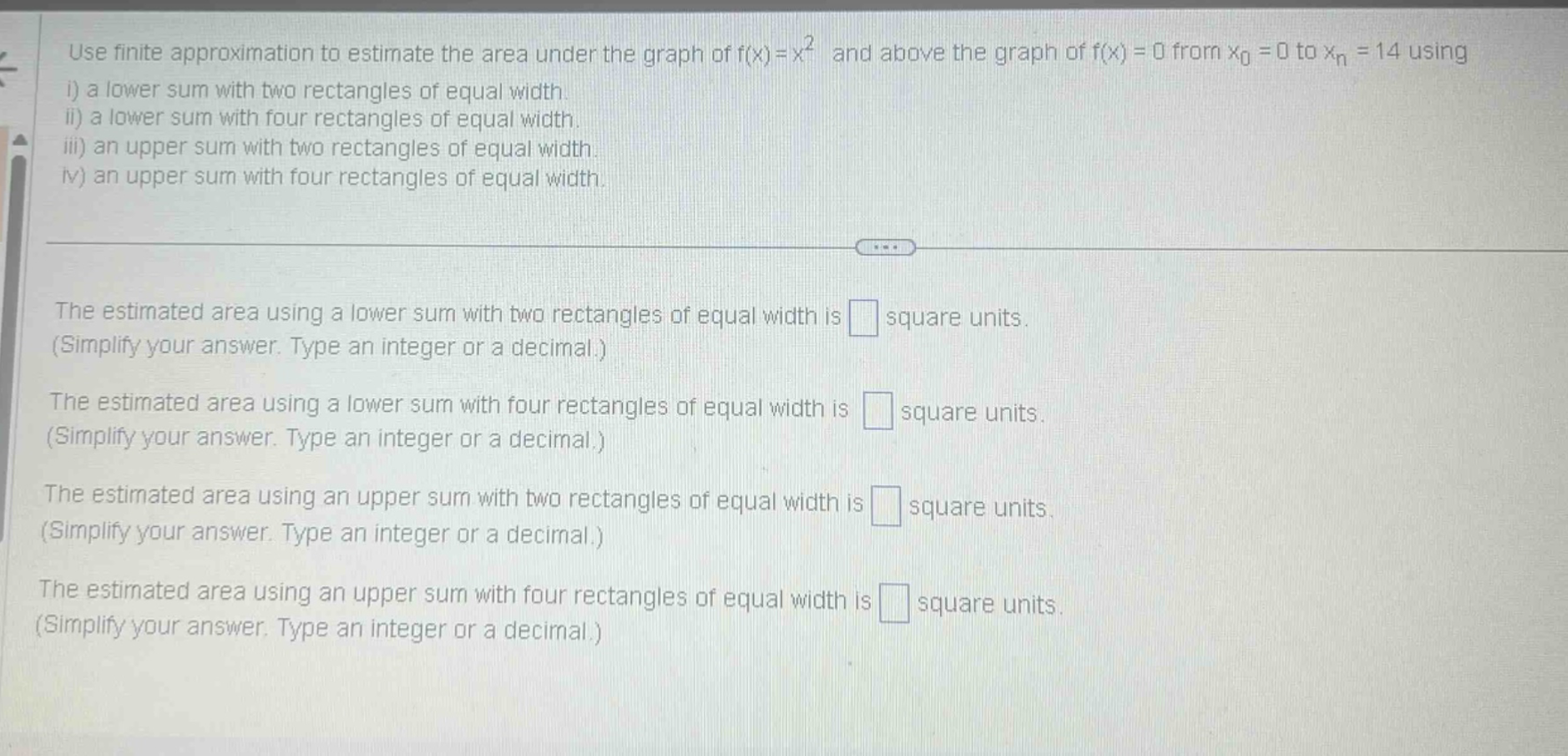
use finite approximation to estimate the area under the graph of f(x)=x² and above the graph of f(x)=0 from x₀ = 0 to xₙ = 14 using i) a lower sum with two rectangles of equal width. ii) a lower sum with four rectangles of equal width. iii) an upper sum with two rectangles of equal width. iv) an upper sum with four rectangles of equal width. the estimated area using a lower sum with two rectangles of equal width is square units. (simplify your answer. type an integer or a decimal.) the estimated area using a lower sum with four rectangles of equal width is square units. (simplify your answer. type an integer or a decimal.) the estimated area using an upper sum with two rectangles of equal width is square units. (simplify your answer. type an integer or a decimal.) the estimated area using an upper sum with four rectangles of equal width is square units. (simplify your answer. type an integer or a decimal.)
Answer
Explanation:
Step1: Calculate width of rectangles
For (n) rectangles on ([a,b]=[0,14]), the width (\Delta x=\frac{b - a}{n}).
Step2: Lower - sum with two rectangles
(n = 2), (\Delta x=\frac{14-0}{2}=7). The sub - intervals are ([0,7]) and ([7,14]). For a lower sum, we use the minimum value of (y = f(x)=x^{2}) on each sub - interval. The minimum on ([0,7]) is (f(0)=0) and on ([7,14]) is (f(7)=49). The lower sum (L_2=\sum_{i = 0}^{1}f(x_i)\Delta x=f(0)\times7 + f(7)\times7=0\times7+49\times7 = 343).
Step3: Lower - sum with four rectangles
(n = 4), (\Delta x=\frac{14 - 0}{4}=3.5). The sub - intervals are ([0,3.5]), ([3.5,7]), ([7,10.5]), ([10.5,14]). The minimum values are (f(0)=0), (f(3.5)=3.5^{2}=12.25), (f(7)=49), (f(10.5)=10.5^{2}=110.25). The lower sum (L_4=\sum_{i = 0}^{3}f(x_i)\Delta x=(0 + 12.25+49+110.25)\times3.5=(171.5)\times3.5 = 600.25).
Step4: Upper - sum with two rectangles
(n = 2), (\Delta x = 7). The sub - intervals are ([0,7]) and ([7,14]). For an upper sum, we use the maximum value of (y = f(x)=x^{2}) on each sub - interval. The maximum on ([0,7]) is (f(7)=49) and on ([7,14]) is (f(14)=196). The upper sum (U_2=\sum_{i = 0}^{1}f(x_{i + 1})\Delta x=f(7)\times7+f(14)\times7=49\times7 + 196\times7=(49 + 196)\times7=245\times7=1715).
Step5: Upper - sum with four rectangles
(n = 4), (\Delta x=3.5). The sub - intervals are ([0,3.5]), ([3.5,7]), ([7,10.5]), ([10.5,14]). The maximum values are (f(3.5)=12.25), (f(7)=49), (f(10.5)=110.25), (f(14)=196). The upper sum (U_4=\sum_{i = 0}^{3}f(x_{i+1})\Delta x=(12.25 + 49+110.25+196)\times3.5=(367.5)\times3.5 = 1286.25).
Answer:
The estimated area using a lower sum with two rectangles of equal width is (343) square units. The estimated area using a lower sum with four rectangles of equal width is (600.25) square units. The estimated area using an upper sum with two rectangles of equal width is (1715) square units. The estimated area using an upper sum with four rectangles of equal width is (1286.25) square units.