use the first derivative test to find the location of all local extrema for the function given below. enter…
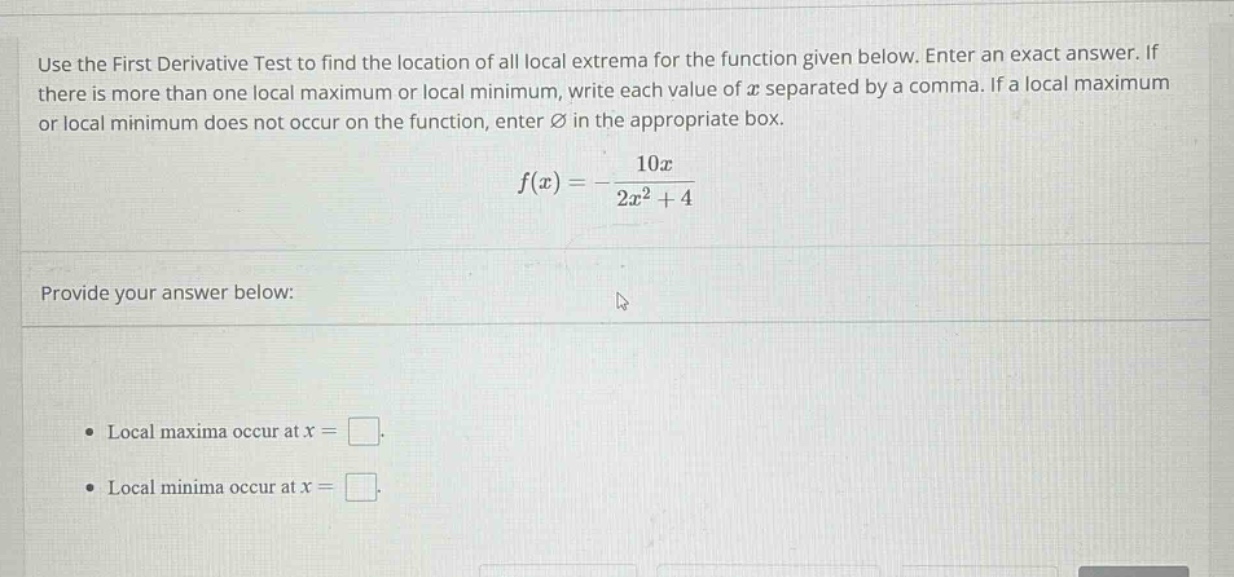
use the first derivative test to find the location of all local extrema for the function given below. enter an exact answer. if there is more than one local maximum or local minimum, write each value of x separated by a comma. if a local maximum or local minimum does not occur on the function, enter ∅ in the appropriate box. f(x)=-10x/(2x² + 4) provide your answer below: • local maxima occur at x = . • local minima occur at x = .
Answer
Explanation:
Step1: Find the derivative of $f(x)$
Use the quotient - rule. If $f(x)=-\frac{10x}{2x^{2}+4}$, and the quotient - rule states that if $y = \frac{u}{v}$, then $y^\prime=\frac{u^\prime v - uv^\prime}{v^{2}}$. Here, $u=- 10x$, $u^\prime=-10$, $v = 2x^{2}+4$, $v^\prime = 4x$. Then $f^\prime(x)=-\frac{-10(2x^{2}+4)-(-10x)(4x)}{(2x^{2}+4)^{2}}=\frac{- 20x^{2}-40 + 40x^{2}}{(2x^{2}+4)^{2}}=\frac{20x^{2}-40}{(2x^{2}+4)^{2}}$.
Step2: Find the critical points
Set $f^\prime(x) = 0$. So $\frac{20x^{2}-40}{(2x^{2}+4)^{2}}=0$. Since the denominator $(2x^{2}+4)^{2}>0$ for all real $x$, we set the numerator equal to zero: $20x^{2}-40 = 0$. Then $x^{2}=2$, which gives $x=\pm\sqrt{2}$.
Step3: Use the first - derivative test
Choose test points in the intervals $(-\infty,-\sqrt{2})$, $(-\sqrt{2},\sqrt{2})$, and $(\sqrt{2},\infty)$. For the interval $(-\infty,-\sqrt{2})$, let $x=-2$. Then $f^\prime(-2)=\frac{20\times(-2)^{2}-40}{(2\times(-2)^{2}+4)^{2}}=\frac{80 - 40}{(8 + 4)^{2}}=\frac{40}{144}>0$. For the interval $(-\sqrt{2},\sqrt{2})$, let $x = 0$. Then $f^\prime(0)=\frac{20\times0^{2}-40}{(2\times0^{2}+4)^{2}}=\frac{-40}{16}<0$. For the interval $(\sqrt{2},\infty)$, let $x = 2$. Then $f^\prime(2)=\frac{20\times2^{2}-40}{(2\times2^{2}+4)^{2}}=\frac{80 - 40}{(8 + 4)^{2}}=\frac{40}{144}>0$.
Since $f(x)$ changes from increasing ($f^\prime(x)>0$) to decreasing ($f^\prime(x)<0$) at $x =-\sqrt{2}$, $f(x)$ has a local maximum at $x =-\sqrt{2}$. Since $f(x)$ changes from decreasing ($f^\prime(x)<0$) to increasing ($f^\prime(x)>0$) at $x=\sqrt{2}$, $f(x)$ has a local minimum at $x=\sqrt{2}$.
Answer:
Local maxima occur at $x =-\sqrt{2}$. Local minima occur at $x=\sqrt{2}$.