use the following information to complete parts a. and b. below. f(x)=sin x, a = π/3 a. find the first three…
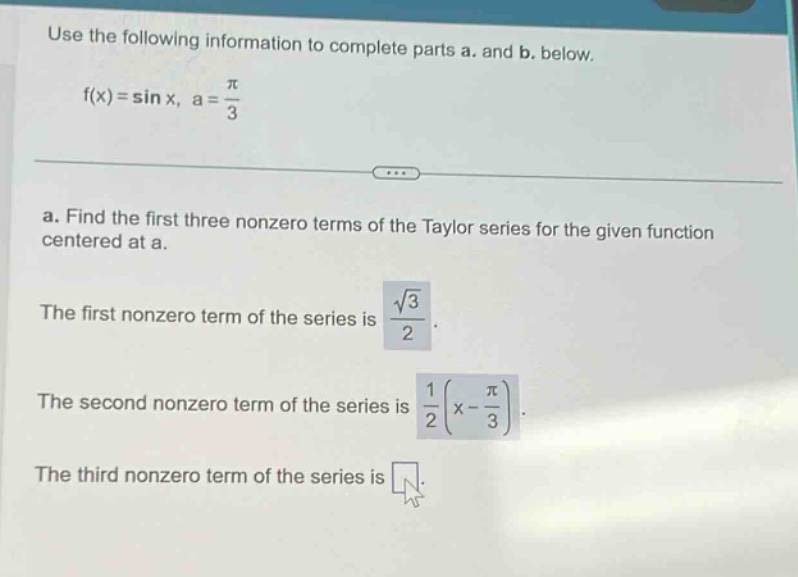
use the following information to complete parts a. and b. below. f(x)=sin x, a = π/3 a. find the first three nonzero terms of the taylor series for the given function centered at a. the first nonzero term of the series is √3/2. the second nonzero term of the series is 1/2(x - π/3). the third nonzero term of the series is
Answer
Explanation:
Step1: Recall Taylor - series formula
The Taylor series of a function $f(x)$ centered at $a$ is given by $f(x)=\sum_{n = 0}^{\infty}\frac{f^{(n)}(a)}{n!}(x - a)^n=f(a)+f^{\prime}(a)(x - a)+\frac{f^{\prime\prime}(a)}{2!}(x - a)^2+\frac{f^{(3)}(a)}{3!}(x - a)^3+\cdots$. We have $f(x)=\sin x$, $a = \frac{\pi}{3}$. First, find the derivatives of $f(x)$.
Step2: Find the second - derivative of $f(x)$
The first - derivative $f^{\prime}(x)=\cos x$, and the second - derivative $f^{\prime\prime}(x)=-\sin x$.
Step3: Evaluate the second - derivative at $a=\frac{\pi}{3}$
$f^{\prime\prime}(\frac{\pi}{3})=-\sin(\frac{\pi}{3})=-\frac{\sqrt{3}}{2}$.
Step4: Calculate the third non - zero term
The third non - zero term is $\frac{f^{\prime\prime}(a)}{2!}(x - a)^2$. Substituting $a=\frac{\pi}{3}$ and $f^{\prime\prime}(\frac{\pi}{3})=-\frac{\sqrt{3}}{2}$ into the formula, we get $\frac{-\frac{\sqrt{3}}{2}}{2}(x-\frac{\pi}{3})^2=-\frac{\sqrt{3}}{4}(x - \frac{\pi}{3})^2$.
Answer:
$-\frac{\sqrt{3}}{4}(x-\frac{\pi}{3})^2$