use the following information to complete parts a. and b. below. f(x)=sin x, a = π/3 a. find the first three…
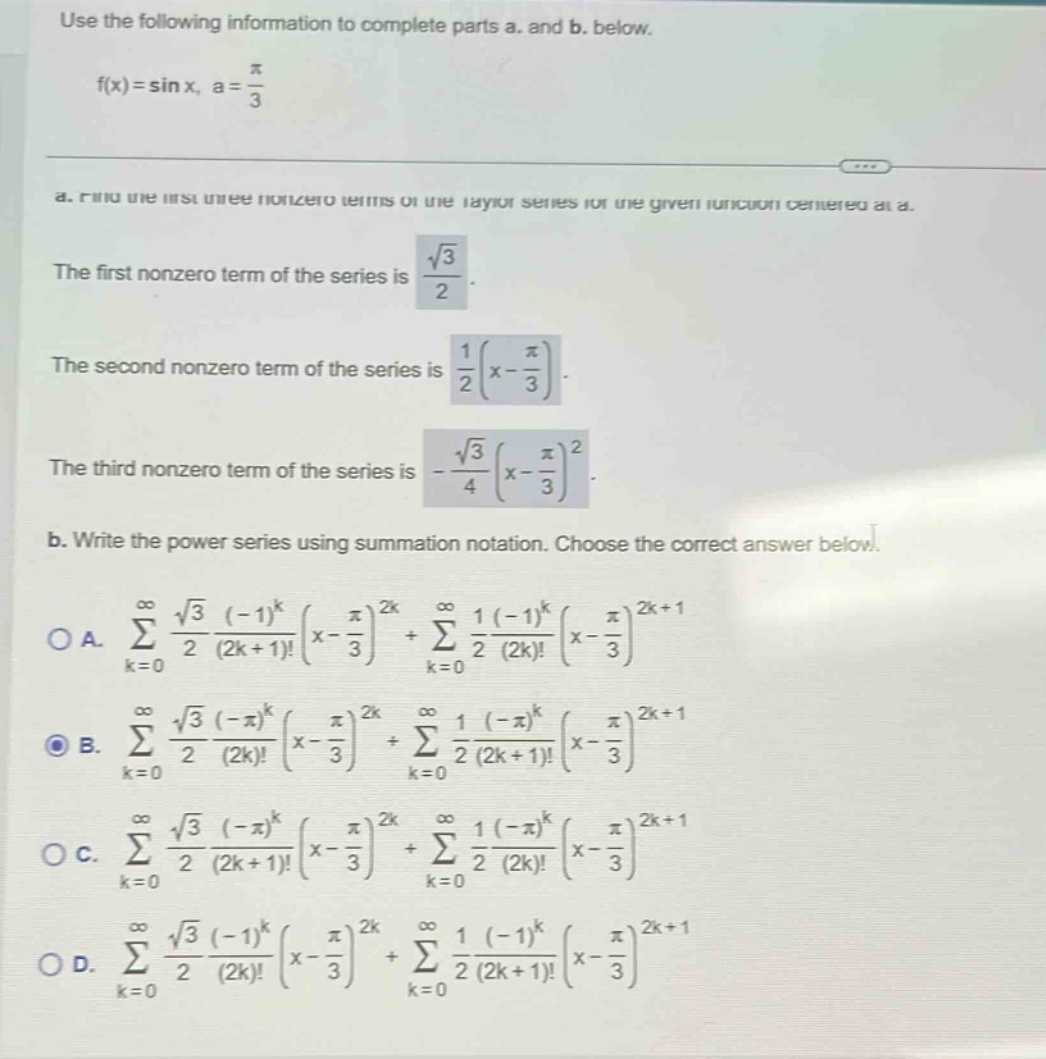
use the following information to complete parts a. and b. below. f(x)=sin x, a = π/3 a. find the first three nonzero terms of the taylor series for the given function centered at a. the first nonzero term of the series is √3/2. the second nonzero term of the series is 1/2(x - π/3). the third nonzero term of the series is -√3/4(x - π/3)^2. b. write the power series using summation notation. choose the correct answer below. oa. ∑(k = 0 to ∞) √3/2 (-1)^k/(2k + 1)!(x - π/3)^2k + ∑(k = 0 to ∞) 1/2 (-1)^k/(2k)!(x - π/3)^2k + 1 ob. ∑(k = 0 to ∞) √3/2 (-π)^k/(2k)!(x - π/3)^2k + ∑(k = 0 to ∞) 1/2 (-π)^k/(2k + 1)!(x - π/3)^2k + 1 oc. ∑(k = 0 to ∞) √3/2 (-π)^k/(2k + 1)!(x - π/3)^2k + ∑(k = 0 to ∞) 1/2 (-π)^k/(2k)!(x - π/3)^2k + 1 od. ∑(k = 0 to ∞) √3/2 (-1)^k/(2k)!(x - π/3)^2k + ∑(k = 0 to ∞) 1/2 (-1)^k/(2k + 1)!(x - π/3)^2k + 1
Answer
Explanation:
Step1: Recall the Taylor - series formula
The Taylor series of a function (f(x)) centered at (a) is given by (f(x)=\sum_{k = 0}^{\infty}\frac{f^{(k)}(a)}{k!}(x - a)^{k}), where (f^{(k)}(a)) is the (k) - th derivative of (f(x)) evaluated at (x=a). For (f(x)=\sin x), (f^{(0)}(x)=\sin x), (f^{(1)}(x)=\cos x), (f^{(2)}(x)=-\sin x), (f^{(3)}(x)=-\cos x), (f^{(4)}(x)=\sin x), and the derivatives repeat with a period of 4. And (a = \frac{\pi}{3}), so (f(\frac{\pi}{3})=\sin\frac{\pi}{3}=\frac{\sqrt{3}}{2}), (f^{\prime}(\frac{\pi}{3})=\cos\frac{\pi}{3}=\frac{1}{2}), (f^{\prime\prime}(\frac{\pi}{3})=-\sin\frac{\pi}{3}=-\frac{\sqrt{3}}{2}), (f^{\prime\prime\prime}(\frac{\pi}{3})=-\cos\frac{\pi}{3}=-\frac{1}{2}).
Step2: Analyze the general form of the Taylor - series for (\sin x) centered at (a=\frac{\pi}{3})
The general form of the Taylor series of (y = \sin x) centered at (x = a) is (\sin x=\sum_{k = 0}^{\infty}\frac{\sin(a+\frac{k\pi}{2})}{k!}(x - a)^{k}). When (a=\frac{\pi}{3}), we know that: The even - numbered derivatives of (\sin x) at (x=\frac{\pi}{3}) are of the form (\sin(\frac{\pi}{3}+n\pi)) and the odd - numbered derivatives are of the form (\cos(\frac{\pi}{3}+n\pi)). The Taylor series of (\sin x) centered at (x=\frac{\pi}{3}) is (\sin x=\sum_{k = 0}^{\infty}\frac{\sin(\frac{\pi}{3}+\frac{k\pi}{2})}{k!}(x - \frac{\pi}{3})^{k}). The even - numbered terms ((k = 2m)): (f^{(2m)}(\frac{\pi}{3})=\sin(\frac{\pi}{3}+m\pi)). When (m = 0), (f( \frac{\pi}{3})=\sin\frac{\pi}{3}=\frac{\sqrt{3}}{2}), and the general form of the even - numbered terms is (\sum_{m = 0}^{\infty}\frac{\sqrt{3}(-1)^{m}}{2(2m)!}(x - \frac{\pi}{3})^{2m}). The odd - numbered terms ((k=2m + 1)): (f^{(2m + 1)}(\frac{\pi}{3})=\cos(\frac{\pi}{3}+m\pi)). When (m = 0), (f^{\prime}(\frac{\pi}{3})=\cos\frac{\pi}{3}=\frac{1}{2}), and the general form of the odd - numbered terms is (\sum_{m = 0}^{\infty}\frac{1(-1)^{m}}{2(2m+1)!}(x - \frac{\pi}{3})^{2m + 1}). Combining them, we get (\sin x=\sum_{k = 0}^{\infty}\frac{\sqrt{3}(-1)^{k}}{2(2k)!}(x - \frac{\pi}{3})^{2k}+\sum_{k = 0}^{\infty}\frac{1(-1)^{k}}{2(2k + 1)!}(x - \frac{\pi}{3})^{2k+1})
Answer:
D. (\sum_{k = 0}^{\infty}\frac{\sqrt{3}(-1)^{k}}{2(2k)!}(x-\frac{\pi}{3})^{2k}+\sum_{k = 0}^{\infty}\frac{1(-1)^{k}}{2(2k + 1)!}(x-\frac{\pi}{3})^{2k + 1})