use the following information to complete parts a. and b. below.\nf(x) = \\(\\sqrt4{1 + x}\\); approximate…
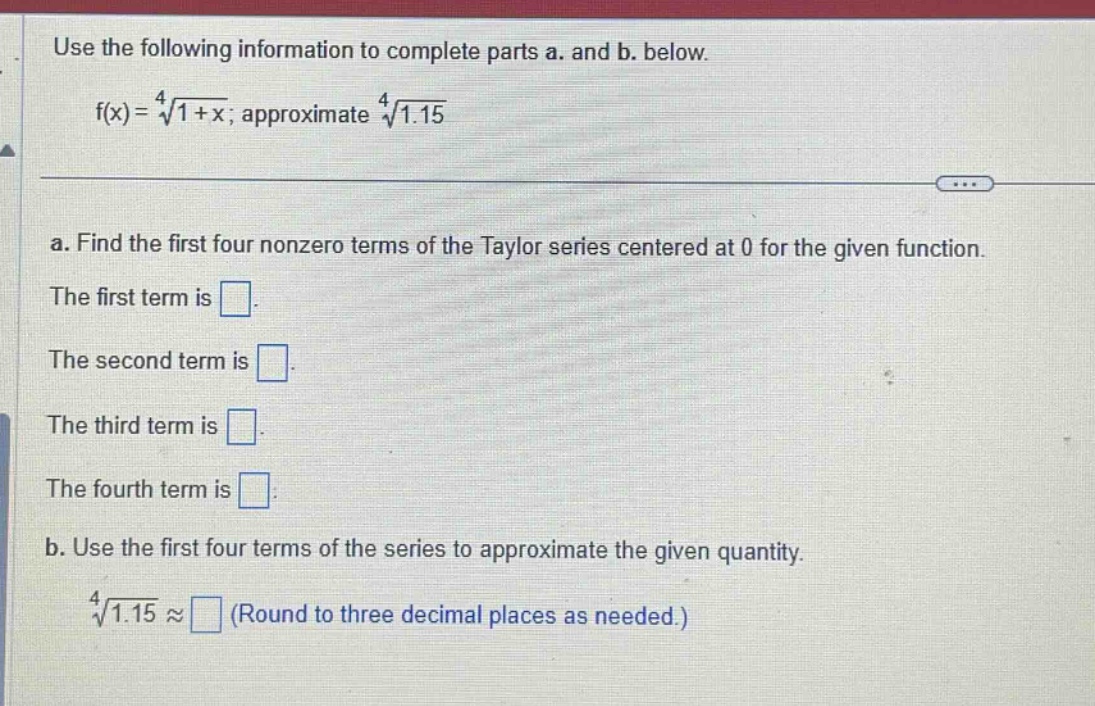
use the following information to complete parts a. and b. below.\nf(x) = \\(\\sqrt4{1 + x}\\); approximate \\(\\sqrt4{1.15})\na. find the first four nonzero terms of the taylor series centered at 0 for the given function.\nthe first term is \nthe second term is \nthe third term is \nthe fourth term is \nb. use the first four terms of the series to approximate the given quantity.\n\\(\\sqrt4{1.15}\\) \\(\\approx\\) (round to three decimal places as needed.)
Answer
Explanation:
Step1: Recall Taylor - series formula
The Taylor series of a function $f(x)$ centered at $a = 0$ is given by $f(x)=\sum_{n = 0}^{\infty}\frac{f^{(n)}(0)}{n!}x^{n}=f(0)+f^{\prime}(0)x+\frac{f^{\prime\prime}(0)}{2!}x^{2}+\frac{f^{(3)}(0)}{3!}x^{3}+\cdots$, where $f^{(n)}(0)$ is the $n$-th derivative of $f(x)$ evaluated at $x = 0$. Let $f(x)=(1 + x)^{\frac{1}{4}}$.
Step2: Find $f(0)$
$f(0)=(1+0)^{\frac{1}{4}} = 1$.
Step3: Find the first - derivative $f^{\prime}(x)$
Using the power rule $(u^{n})^\prime=nu^{n - 1}u^\prime$, if $u = 1 + x$ and $n=\frac{1}{4}$, then $f^{\prime}(x)=\frac{1}{4}(1 + x)^{-\frac{3}{4}}$. So, $f^{\prime}(0)=\frac{1}{4}(1+0)^{-\frac{3}{4}}=\frac{1}{4}$.
Step4: Find the second - derivative $f^{\prime\prime}(x)$
$f^{\prime\prime}(x)=\frac{1}{4}\times(-\frac{3}{4})(1 + x)^{-\frac{7}{4}}=-\frac{3}{16}(1 + x)^{-\frac{7}{4}}$. Then $f^{\prime\prime}(0)=-\frac{3}{16}(1 + 0)^{-\frac{7}{4}}=-\frac{3}{16}$.
Step5: Find the third - derivative $f^{(3)}(x)$
$f^{(3)}(x)=-\frac{3}{16}\times(-\frac{7}{4})(1 + x)^{-\frac{11}{4}}=\frac{21}{64}(1 + x)^{-\frac{11}{4}}$. So, $f^{(3)}(0)=\frac{21}{64}(1 + 0)^{-\frac{11}{4}}=\frac{21}{64}$.
Step6: Write the first four non - zero terms of the Taylor series
The first term: $\frac{f(0)}{0!}=1$. The second term: $\frac{f^{\prime}(0)}{1!}x=\frac{1}{4}x$. The third term: $\frac{f^{\prime\prime}(0)}{2!}x^{2}=\frac{-\frac{3}{16}}{2}x^{2}=-\frac{3}{32}x^{2}$. The fourth term: $\frac{f^{(3)}(0)}{3!}x^{3}=\frac{\frac{21}{64}}{6}x^{3}=\frac{7}{128}x^{3}$.
Step7: Approximate $\sqrt[4]{1.15}$
We want to approximate $\sqrt[4]{1.15}=(1 + 0.15)^{\frac{1}{4}}$. Substitute $x = 0.15$ into the first four terms of the Taylor series: [ \begin{align*} (1 + 0.15)^{\frac{1}{4}}&\approx1+\frac{1}{4}(0.15)-\frac{3}{32}(0.15)^{2}+\frac{7}{128}(0.15)^{3}\ &=1 + 0.0375-\frac{3}{32}\times0.0225+\frac{7}{128}\times0.003375\ &=1 + 0.0375-0.002109375 + 0.000185546875\ &\approx1.035 \end{align*} ]
Answer:
The first term is $1$. The second term is $\frac{1}{4}x$. The third term is $-\frac{3}{32}x^{2}$. The fourth term is $\frac{7}{128}x^{3}$. $\sqrt[4]{1.15}\approx1.035$