use the function below to answer the following questions.\n\n$y = \\log_3(x + 3)$\n\n(a) use transformations…
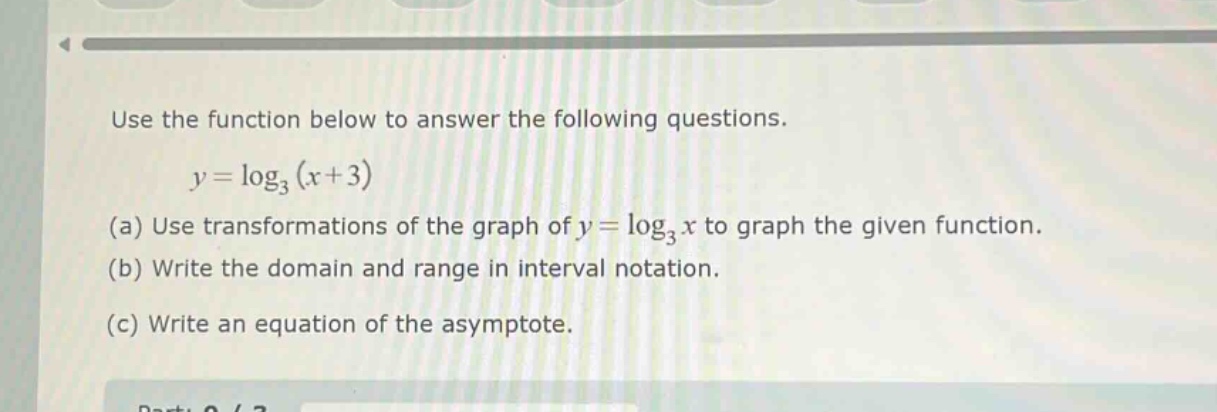
use the function below to answer the following questions.\n\n$y = \\log_3(x + 3)$\n\n(a) use transformations of the graph of $y = \\log_3 x$ to graph the given function.\n\n(b) write the domain and range in interval notation.\n\n(c) write an equation of the asymptote.
Answer
Explanation:
Step1: Analyze the transformation
The function (y = \log_{3}(x + 3)) is a horizontal shift of (y=\log_{3}x). The transformation rule for (y = f(x + h)) is a shift of (y = f(x)) to the left by (h) units. Here (h = 3), so the graph of (y=\log_{3}x) is shifted 3 units to the left.
Step2: Find the domain
For the function (y=\log_{3}(x + 3)), the argument of the logarithm must be positive. So (x+3>0), which gives (x>- 3). In interval notation, the domain is ((-3,\infty)).
Step3: Find the range
The range of any logarithmic function of the form (y = \log_{a}(x + h)+k) (where (a>0,a\neq1)) is ((-\infty,\infty)). So for (y=\log_{3}(x + 3)), the range is ((-\infty,\infty))
Step4: Find the vertical asymptote
For the function (y=\log_{3}(x + 3)), as (x+3\rightarrow0^{+}) (i.e., (x\rightarrow - 3^{+})), (y\rightarrow-\infty). The vertical asymptote is (x=-3)
Answer:
- (a) Shift the graph of (y = \log_{3}x) 3 units to the left.
- (b) Domain: ((-3,\infty)), Range: ((-\infty,\infty))
- (c) (x=-3)