use the function below to answer the following questions\n\n$f(x)=e^{x - 6}$\n\n(a) use transformations of…
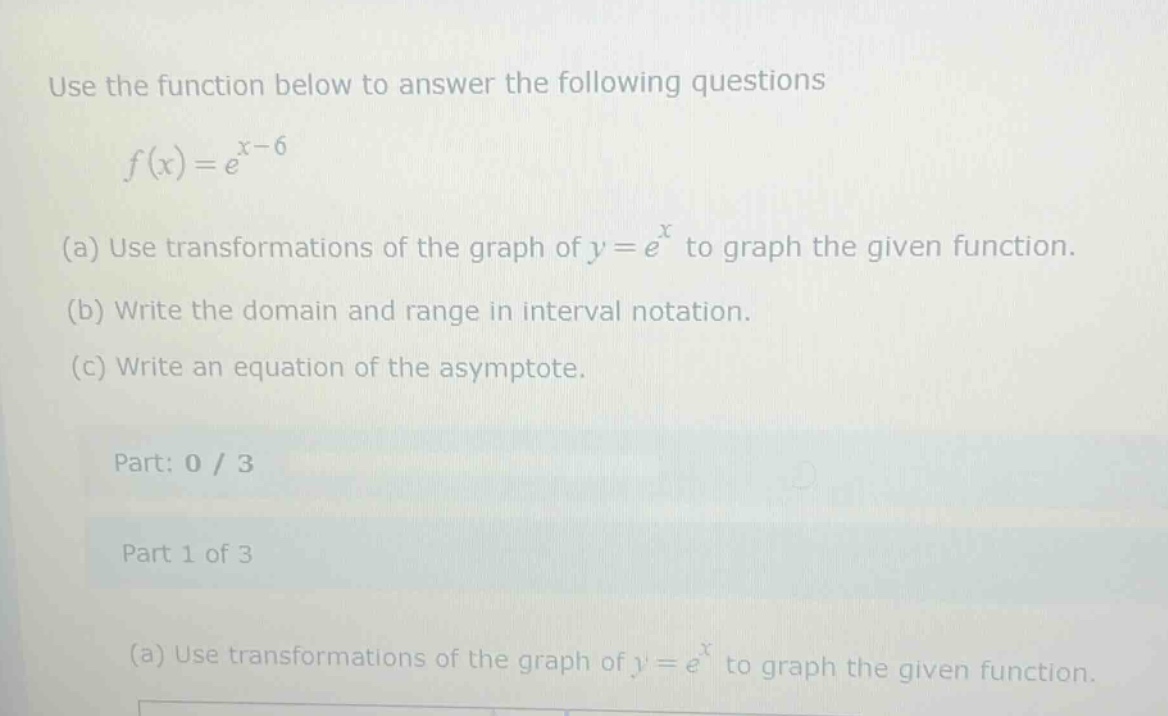
use the function below to answer the following questions\n\n$f(x)=e^{x - 6}$\n\n(a) use transformations of the graph of $y = e^{x}$ to graph the given function.\n(b) write the domain and range in interval notation.\n(c) write an equation of the asymptote.\n\npart: 0 / 3\n\npart 1 of 3\n\n(a) use transformations of the graph of $y = e^{x}$ to graph the given function.
Answer
Explanation:
Step1: Recall graph - transformation rules
The function $y = f(x - h)$ is a horizontal shift of the function $y = f(x)$. For the function $y=e^{x - 6}$, compared to $y = e^{x}$, it is a horizontal shift of 6 units to the right. The graph of $y = e^{x}$ has a y - intercept at $(0,1)$ (since when $x = 0$, $y=e^{0}=1$). For the function $y = e^{x - 6}$, when $x = 6$, $y=e^{6 - 6}=e^{0}=1$. So the y - intercept of $y = e^{x - 6}$ is shifted 6 units to the right.
Step2: Find the domain
The exponential function $y = e^{x-6}$ is defined for all real - valued x. In interval notation, the domain is $(-\infty,\infty)$.
Step3: Find the range
The exponential function $y = e^{u}$, where $u=x - 6$, always has a positive output. Since $e^{u}>0$ for all real u, the range of $y = e^{x - 6}$ is $(0,\infty)$.
Step4: Find the asymptote
The exponential function $y = e^{x-6}$ has a horizontal asymptote. As $x\to-\infty$, $u=x - 6\to-\infty$, and $e^{x - 6}\to0$. So the equation of the horizontal asymptote is $y = 0$.
Answer:
(a) Shift the graph of $y = e^{x}$ 6 units to the right. (b) Domain: $(-\infty,\infty)$; Range: $(0,\infty)$ (c) $y = 0$