use the function below to answer parts (a)-(d). f(x) = 3/2 x^2 (a) graph the function. (b) draw lines…
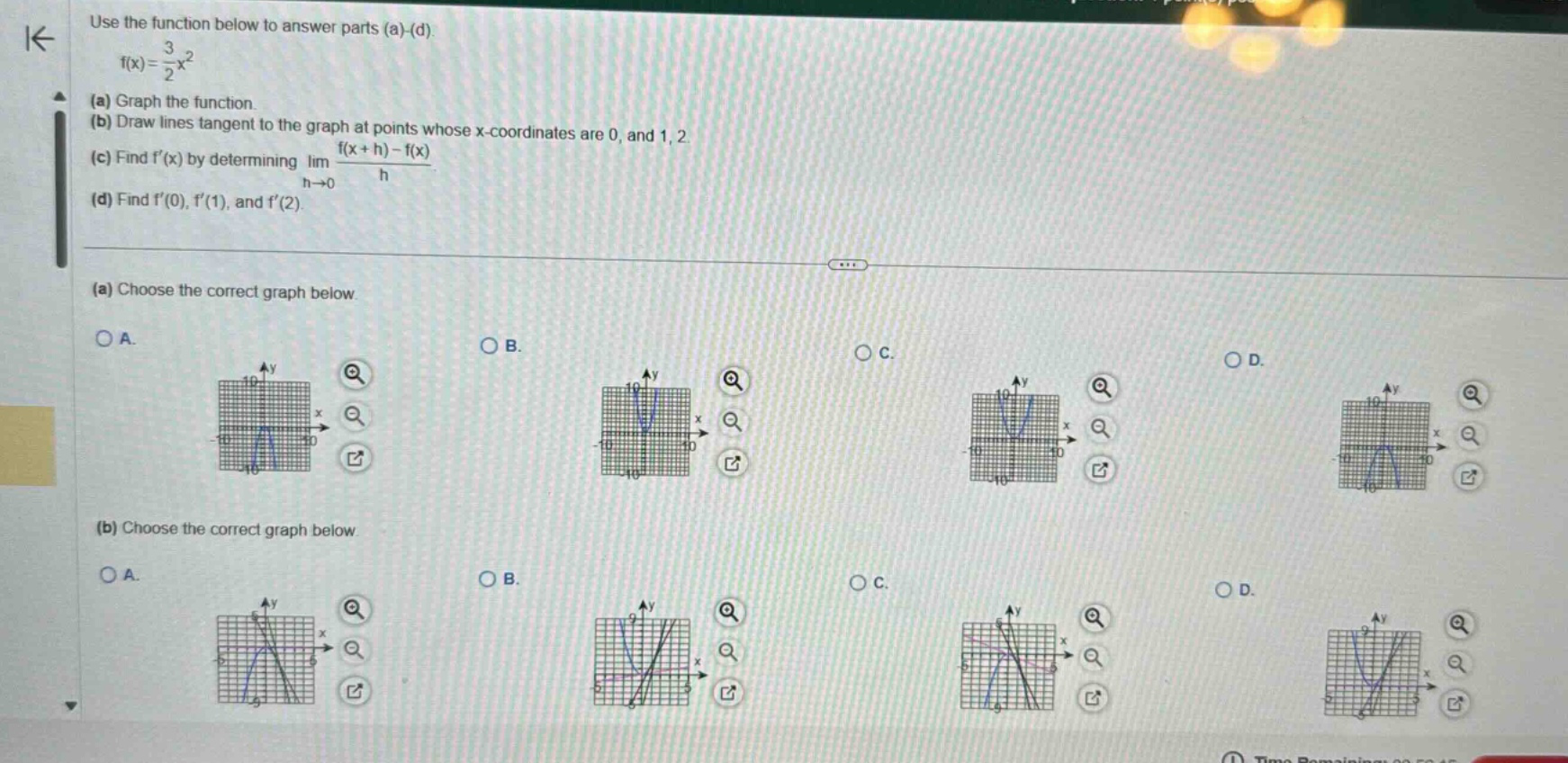
use the function below to answer parts (a)-(d). f(x) = 3/2 x^2 (a) graph the function. (b) draw lines tangent to the graph at points whose x - coordinates are 0, and 1, 2. (c) find f(x) by determining lim h→0 (f(x + h)-f(x))/h (d) find f(0), f(1), and f(2). (a) choose the correct graph below. (b) choose the correct graph below.
Answer
Explanation:
Step1: Analyze the function $f(x)=\frac{3}{2}x^{2}$
It is a quadratic - function of the form $y = ax^{2}+bx + c$ with $a=\frac{3}{2}$, $b = 0$, $c = 0$. The graph of $y = ax^{2}$ is a parabola. Since $a=\frac{3}{2}>0$, the parabola opens upwards and its vertex is at the origin $(0,0)$.
Step2: Find the derivative using the limit definition
We have $f(x)=\frac{3}{2}x^{2}$, then $f(x + h)=\frac{3}{2}(x + h)^{2}=\frac{3}{2}(x^{2}+2xh+h^{2})=\frac{3}{2}x^{2}+3xh+\frac{3}{2}h^{2}$. [ \begin{align*} f^{\prime}(x)&=\lim_{h\rightarrow0}\frac{f(x + h)-f(x)}{h}\ &=\lim_{h\rightarrow0}\frac{\frac{3}{2}x^{2}+3xh+\frac{3}{2}h^{2}-\frac{3}{2}x^{2}}{h}\ &=\lim_{h\rightarrow0}\frac{3xh+\frac{3}{2}h^{2}}{h}\ &=\lim_{h\rightarrow0}(3x+\frac{3}{2}h) \end{align*} ] As $h\rightarrow0$, $f^{\prime}(x)=3x$.
Step3: Evaluate the derivative at specific points
When $x = 0$, $f^{\prime}(0)=3\times0 = 0$. When $x = 1$, $f^{\prime}(1)=3\times1 = 3$. When $x = 2$, $f^{\prime}(2)=3\times2 = 6$.
Answer:
(a) The graph of $y=\frac{3}{2}x^{2}$ is a parabola opening upwards with vertex at the origin. Without seeing the actual options, the general - shape graph should be a parabola opening upwards centered at the origin. (b) At $x = 0$, the slope of the tangent line is $0$ (a horizontal line). At $x = 1$, the slope of the tangent line is $3$ (a line with a positive slope), and at $x = 2$, the slope of the tangent line is $6$ (a steeper line with a positive slope). Without seeing the actual options, the correct graph should show a parabola with horizontal tangent at $x = 0$ and non - horizontal positive - slope tangents at $x = 1$ and $x = 2$. (c) $f^{\prime}(x)=3x$ (d) $f^{\prime}(0)=0$, $f^{\prime}(1)=3$, $f^{\prime}(2)=6$