use the given function f to answer parts (a) through (f). f(x)= - 6+ln x (type your answer in interval…
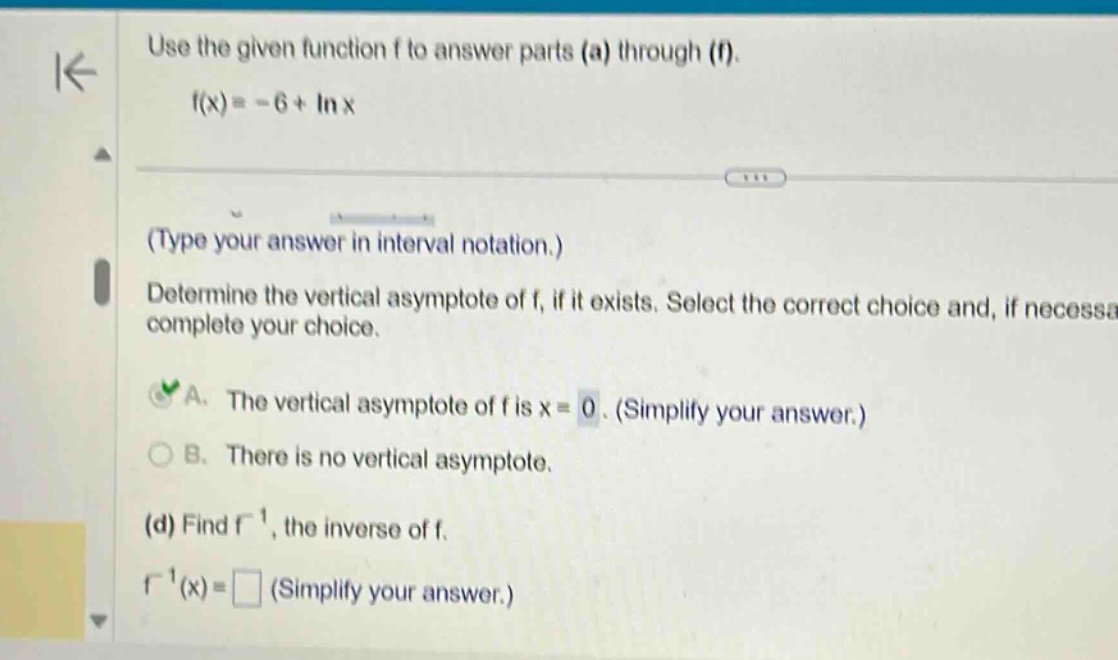
use the given function f to answer parts (a) through (f). f(x)= - 6+ln x (type your answer in interval notation.) determine the vertical asymptote of f, if it exists. select the correct choice and, if necessary, complete your choice. a. the vertical asymptote of f is x = 0. (simplify your answer.) b. there is no vertical asymptote. (d) find f⁻¹, the inverse of f. f⁻¹(x)= (simplify your answer.)
Answer
Explanation:
Step1: Set (y = f(x))
Let (y=-6 + \ln x).
Step2: Solve for (x) in terms of (y)
First, add 6 to both sides: (y + 6=\ln x). Then, use the property that if (y=\ln x), then (x = e^{y}). So (x=e^{y + 6}).
Step3: Replace (x) with (f^{-1}(x)) and (y) with (x)
We get (f^{-1}(x)=e^{x + 6}).
Answer:
(e^{x + 6})