use the given function f to answer parts (a) through (f) below. f(x)=e^(x - 4)-4 (simplify your answer.) b…
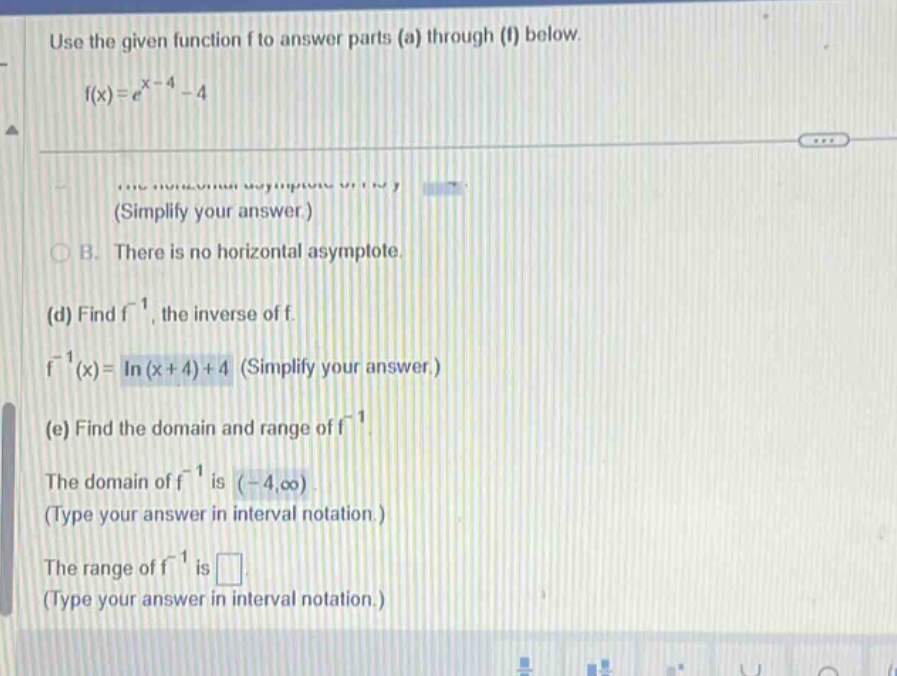
use the given function f to answer parts (a) through (f) below. f(x)=e^(x - 4)-4 (simplify your answer.) b. there is no horizontal asymptote. (d) find f^(-1), the inverse of f. f^(-1)(x)=ln(x + 4)+4 (simplify your answer.) (e) find the domain and range of f^(-1). the domain of f^(-1) is (-4,∞). (type your answer in interval notation.) the range of f^(-1) is . (type your answer in interval notation.)
Answer
Explanation:
Step1: Recall property of inverse functions
The domain of the inverse function $f^{-1}(x)$ is the range of the original function $f(x)$, and the range of the inverse function $f^{-1}(x)$ is the domain of the original function $f(x)$.
Step2: Determine domain of original function
For the function $f(x)=e^{x - 4}-4$, the domain of an exponential - type function $y = e^{u}$ (where $u=x - 4$) is all real numbers, i.e., $(-\infty,\infty)$.
Answer:
$(-\infty,\infty)$