use the graph to answer the following questions. (a) over which intervals is the function decreasing? choose…
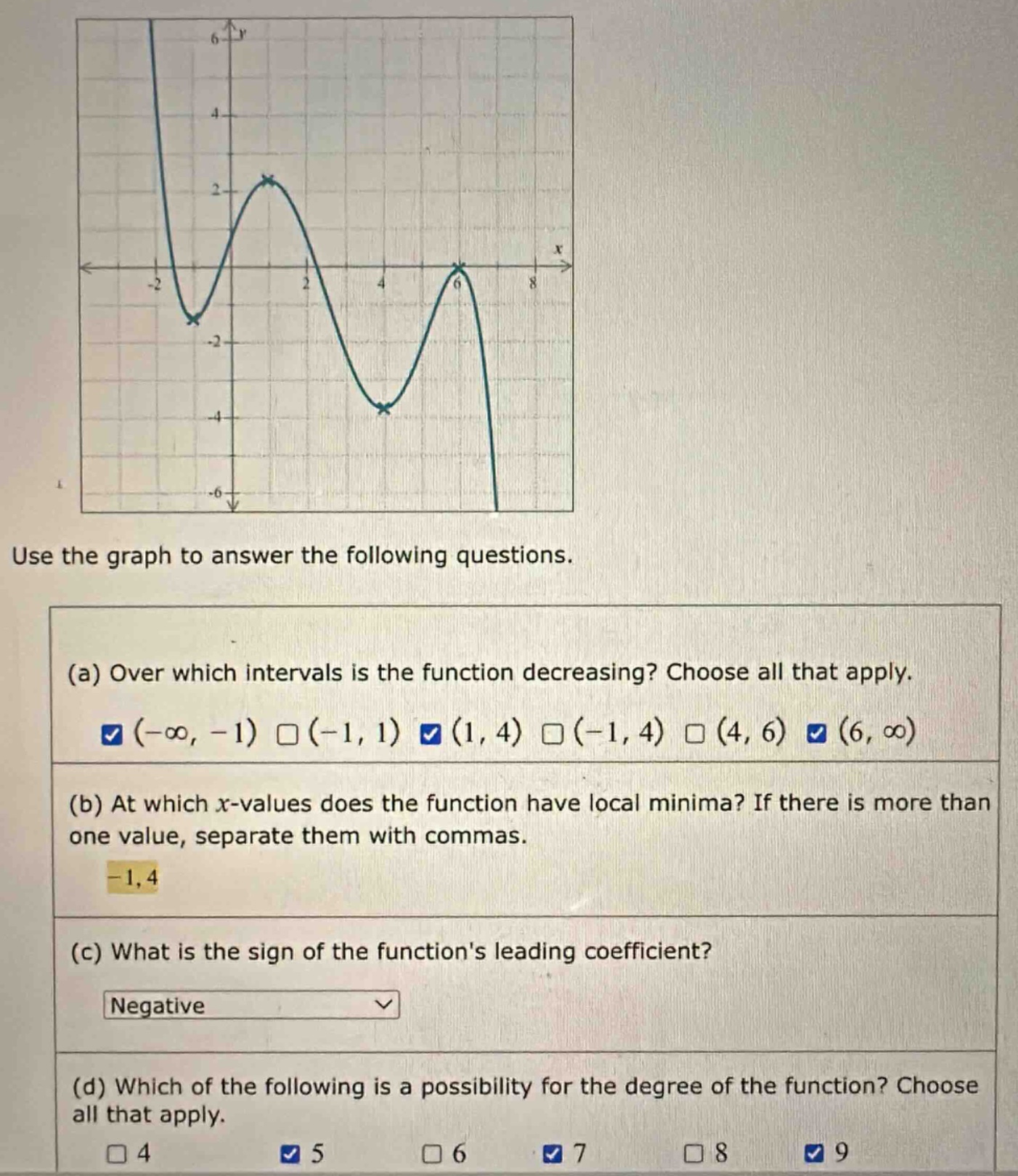
use the graph to answer the following questions. (a) over which intervals is the function decreasing? choose all that apply. (-∞, -1) (-1, 1) (1, 4) (-1, 4) (4, 6) (6, ∞) (b) at which x - values does the function have local minima? if there is more than one value, separate them with commas. -1,4 (c) what is the sign of the functions leading coefficient? negative (d) which of the following is a possibility for the degree of the function? choose all that apply. 4 5 6 7 8 9
Answer
Explanation:
Step1: Identify decreasing intervals
A function is decreasing when its graph goes down - ward as we move from left - to - right. From the graph, we can see the function is decreasing on $(-\infty,-1)$, $(1,4)$ and $(6,\infty)$.
Step2: Locate local minima
Local minima occur at points where the function changes from decreasing to increasing. From the graph, local minima are at $x = - 1$ and $x = 4$.
Step3: Determine sign of leading coefficient
Since the function goes to $-\infty$ as $x\to\pm\infty$, the leading coefficient is negative. For an even - degree polynomial, the function goes to $\infty$ as $x\to\pm\infty$ if the leading coefficient is positive and $-\infty$ as $x\to\pm\infty$ if the leading coefficient is negative. For an odd - degree polynomial, the function goes to $\infty$ as $x\to\infty$ and $-\infty$ as $x\to-\infty$ (or vice - versa) depending on the sign of the leading coefficient. Here, since it goes to $-\infty$ in both directions, the degree must be even and the leading coefficient negative.
Step4: Estimate degree of the function
The number of turning points of a polynomial function of degree $n$ is at most $n - 1$. The graph has 4 turning points. So the degree $n$ satisfies $n-1\geq4$, or $n\geq5$. Also, since the function goes to $-\infty$ as $x\to\pm\infty$, the degree $n$ is even. So possible degrees are odd numbers greater than or equal to 5.
Answer:
(a) $(-\infty,-1),(1,4),(6,\infty)$ (b) $-1,4$ (c) Negative (d) 5,7,9