use the graph to determine the following.\na. the functions domain\nb. the functions range\nc. the x…
use the graph to determine the following.\na. the functions domain\nb. the functions range\nc. the x - intercepts, if any\nd. the y - intercept, if any\ne. the function values f(-2) and f(3)\nassume that the graph of the function continues its trend beyond the displayed coordinate grid.\na. what is the functions domain?\n(type your answer in interval notation.)
Answer
Explanation:
Step1: Determine the function's domain.
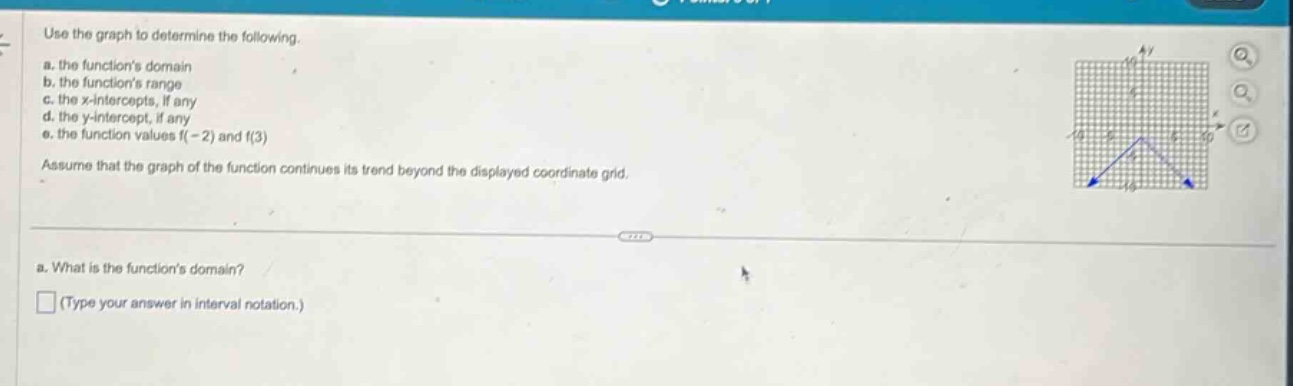
The domain is the set of all possible x-values for which the function is defined. The graph extends indefinitely to the left and to the right, covering all real numbers on the x-axis. $$ \text{Domain: } (-\infty, \infty) $$
Step2: Determine the function's range.
The range is the set of all possible y-values. The graph has a maximum y-value at the vertex, which is $y=4$. The graph extends downwards from this point. $$ \text{Range: } (-\infty, 4] $$
Step3: Determine the x-intercepts.
The x-intercepts are the points where the graph crosses the x-axis (i.e., where $y=0$). From the graph, the function crosses the x-axis at $x=-2$ and $x=6$. $$ x\text{-intercepts: } -2, 6 $$
Step4: Determine the y-intercept.
The y-intercept is the point where the graph crosses the y-axis (i.e., where $x=0$). The left part of the graph passes through $(-2, 0)$ and $(2, 4)$. The slope is $m = \frac{4-0}{2-(-2)} = \frac{4}{4} = 1$. The equation of this line is $y - 0 = 1(x - (-2))$, so $y = x + 2$. For $x=0$, $y = 0 + 2 = 2$. $$ y\text{-intercept: } 2 $$
Step5: Determine the function values $f(-2)$ and $f(3)$.
To find $f(-2)$, locate $x=-2$ on the graph and find the corresponding y-value. From the graph, when $x=-2$, $y=0$. $$ f(-2) = 0 $$ To find $f(3)$, locate $x=3$ on the graph and find the corresponding y-value. The right part of the graph passes through $(2, 4)$ and $(6, 0)$. The slope is $m = \frac{0-4}{6-2} = \frac{-4}{4} = -1$. The equation of this line is $y - 4 = -1(x - 2)$, so $y = -x + 2 + 4$, which is $y = -x + 6$. For $x=3$, $y = -3 + 6 = 3$. $$ f(3) = 3 $$
Answer:
a. The function's domain is $(-\infty, \infty)$. b. The function's range is $(-\infty, 4]$. c. The x-intercepts are -2 and 6. d. The y-intercept is 2. e. $f(-2) = 0$ and $f(3) = 3$.