use the graph to determine a. the functions domain; b. the functions range; c. the x - intercepts, if any…
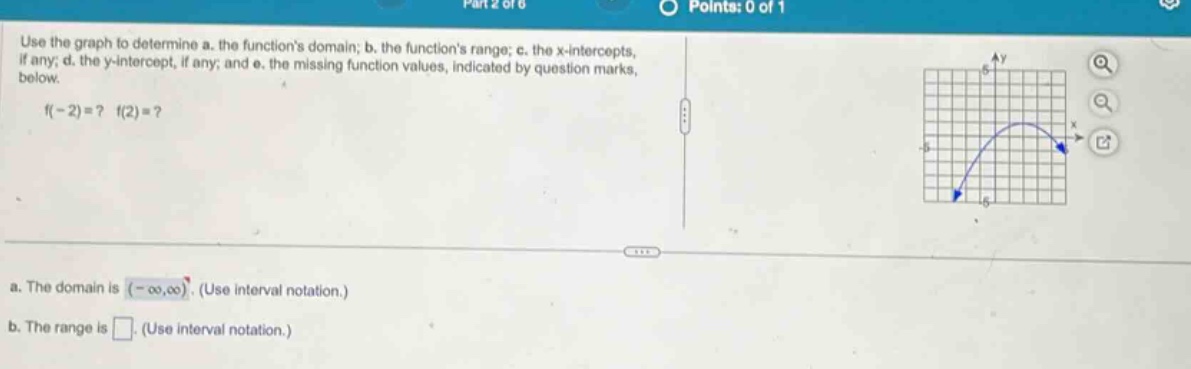
use the graph to determine a. the functions domain; b. the functions range; c. the x - intercepts, if any; d. the y - intercept, if any; and e. the missing function values, indicated by question marks, below. f(-2)=? f(2)=? a. the domain is (-∞,∞). (use interval notation.) b. the range is . (use interval notation.)
Answer
Explanation:
Step1: Determine the function's domain.
The graph extends indefinitely to the left and to the right. Therefore, the domain of the function is all real numbers. $$ \text{Domain: } (-\infty, \infty) $$
Step2: Determine the function's range.
The graph has a maximum value at $y=3$ (the vertex of the parabola) and extends downwards indefinitely. Therefore, the range of the function is all real numbers less than or equal to 3. $$ \text{Range: } (-\infty, 3] $$
Step3: Determine the x-intercepts.
The x-intercepts are the points where the graph crosses the x-axis (i.e., where $y=0$). From the graph, the x-intercepts are at $x=-3$ and $x=3$. $$ \text{x-intercepts: } (-3, 0) \text{ and } (3, 0) $$
Step4: Determine the y-intercept.
The y-intercept is the point where the graph crosses the y-axis (i.e., where $x=0$). From the graph, the y-intercept is at $y=3$. $$ \text{y-intercept: } (0, 3) $$
Step5: Determine the missing function values.
To find $f(-2)$ and $f(2)$, we can observe the graph or use the equation of the parabola. The vertex is $(0,3)$. The parabola passes through $(3,0)$. The equation of a parabola with vertex $(h,k)$ is $f(x) = a(x-h)^2 + k$. So, $f(x) = a(x-0)^2 + 3 = ax^2 + 3$. Since $(3,0)$ is on the graph: $0 = a(3)^2 + 3 \Rightarrow 0 = 9a + 3 \Rightarrow 9a = -3 \Rightarrow a = -\frac{1}{3}$. Thus, the function is $f(x) = -\frac{1}{3}x^2 + 3$. For $f(-2)$: $$ f(-2) = -\frac{1}{3}(-2)^2 + 3 = -\frac{1}{3}(4) + 3 = -\frac{4}{3} + \frac{9}{3} = \frac{5}{3} $$ For $f(2)$: $$ f(2) = -\frac{1}{3}(2)^2 + 3 = -\frac{1}{3}(4) + 3 = -\frac{4}{3} + \frac{9}{3} = \frac{5}{3} $$
Answer:
a. The domain is $(-\infty, \infty)$. b. The range is $(-\infty, 3]$. c. The x-intercepts are $(-3, 0)$ and $(3, 0)$. d. The y-intercept is $(0, 3)$. e. $f(-2) = \frac{5}{3}$, $f(2) = \frac{5}{3}$.