use the graph to evaluate each expression.\n(a) (f + g)(2)\n(b) (f - g)(1)\n(c) (fg)(0)\n(d) (\\frac{f}{g})(1)
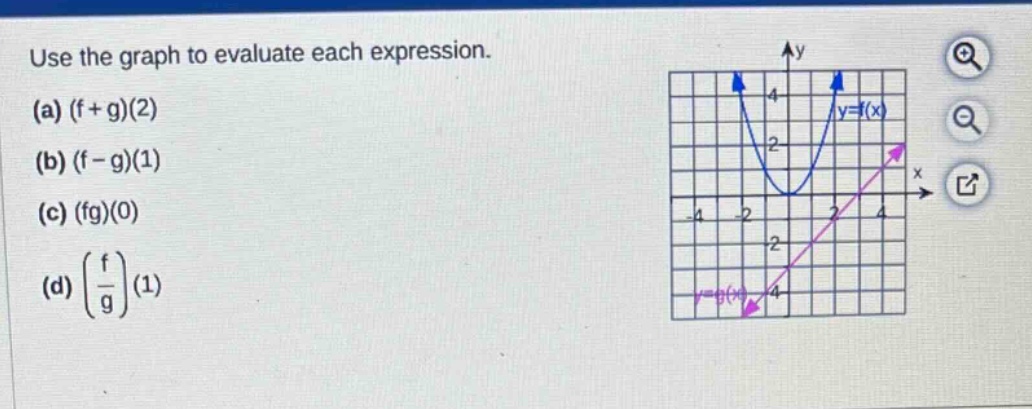
use the graph to evaluate each expression.\n(a) (f + g)(2)\n(b) (f - g)(1)\n(c) (fg)(0)\n(d) (\\frac{f}{g})(1)
Answer
Explanation:
Step1: Recall function - operation rules
$(f + g)(x)=f(x)+g(x)$, $(f - g)(x)=f(x)-g(x)$, $(fg)(x)=f(x)\cdot g(x)$, $\left(\frac{f}{g}\right)(x)=\frac{f(x)}{g(x)}$ ($g(x)\neq0$).
Step2: Find $f(2)$ and $g(2)$ for part (a)
From the graph, when $x = 2$, $f(2)=0$ and $g(2)=2$. Then $(f + g)(2)=f(2)+g(2)=0 + 2=2$.
Step3: Find $f(1)$ and $g(1)$ for part (b)
When $x = 1$, $f(1)=1$ and $g(1)=1$. Then $(f - g)(1)=f(1)-g(1)=1 - 1=0$.
Step4: Find $f(0)$ and $g(0)$ for part (c)
When $x = 0$, $f(0)=1$ and $g(0)=0$. Then $(fg)(0)=f(0)\cdot g(0)=1\times0 = 0$.
Step5: Find $f(1)$ and $g(1)$ for part (d)
When $x = 1$, $f(1)=1$ and $g(1)=1$. Then $\left(\frac{f}{g}\right)(1)=\frac{f(1)}{g(1)}=\frac{1}{1}=1$.
Answer:
(a) 2 (b) 0 (c) 0 (d) 1