use the graph in the figure above to estimate ∫₀³ f(x) dx. round your answer to the nearest integer. ∫₀³…
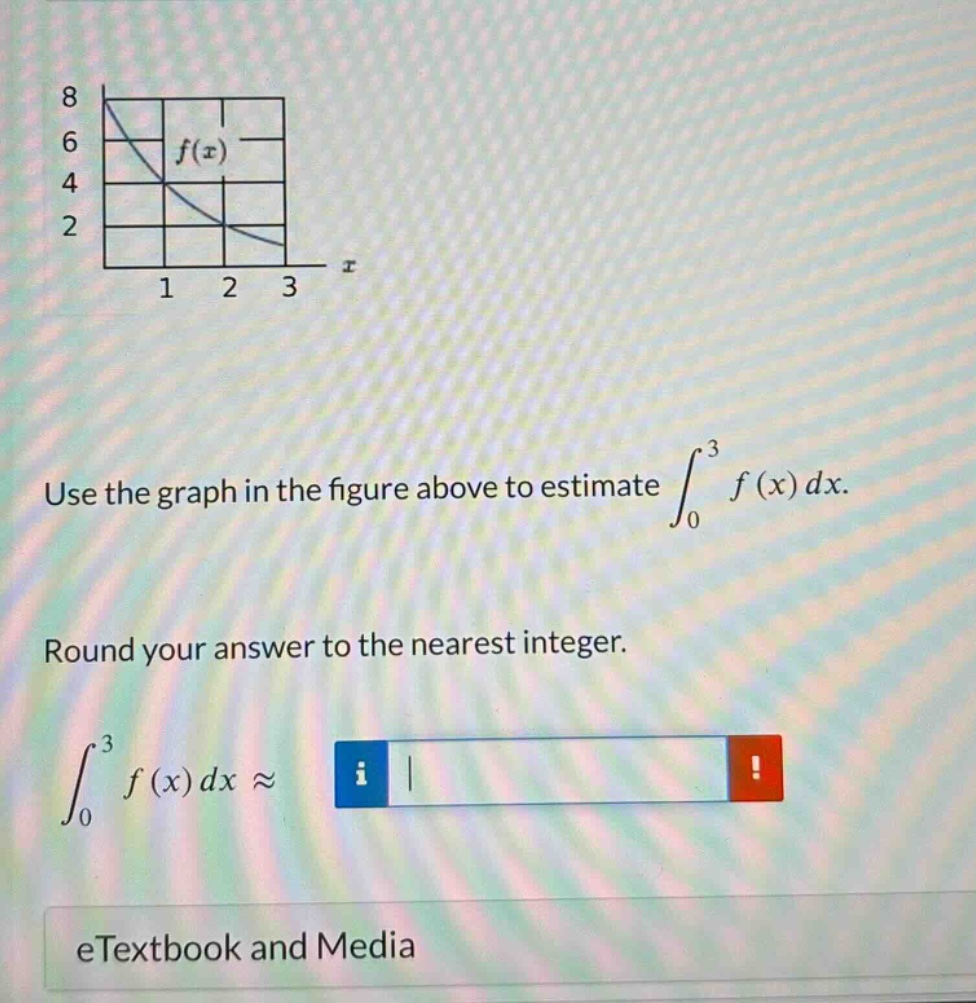
use the graph in the figure above to estimate ∫₀³ f(x) dx. round your answer to the nearest integer. ∫₀³ f(x) dx ≈ etextbook and media
Answer
Explanation:
Step1: Divide the region into rectangles
We can divide the region under the curve from (x = 0) to (x=3) into non - overlapping rectangles. Consider the intervals ([0,1]), ([1,2]) and ([2,3]).
Step2: Estimate the height and width of rectangles
For the interval ([0,1]), the height (h_1\approx 6) and width (w_1 = 1). For ([1,2]), (h_2\approx 4) and (w_2=1). For ([2,3]), (h_3\approx 2) and (w_3 = 1).
Step3: Calculate the area of each rectangle
The area of a rectangle is (A = h\times w). So (A_1=h_1\times w_1=6\times1 = 6), (A_2=h_2\times w_2=4\times1 = 4), (A_3=h_3\times w_3=2\times1=2).
Step4: Estimate the integral
The definite integral (\int_{0}^{3}f(x)dx) is approximated by the sum of the areas of the rectangles (A = A_1+A_2+A_3). So (A=6 + 4+2=12).
Answer:
12