use the graph of g in the figure to do the following. a. find the values of x in (-3,5) at which g is not…
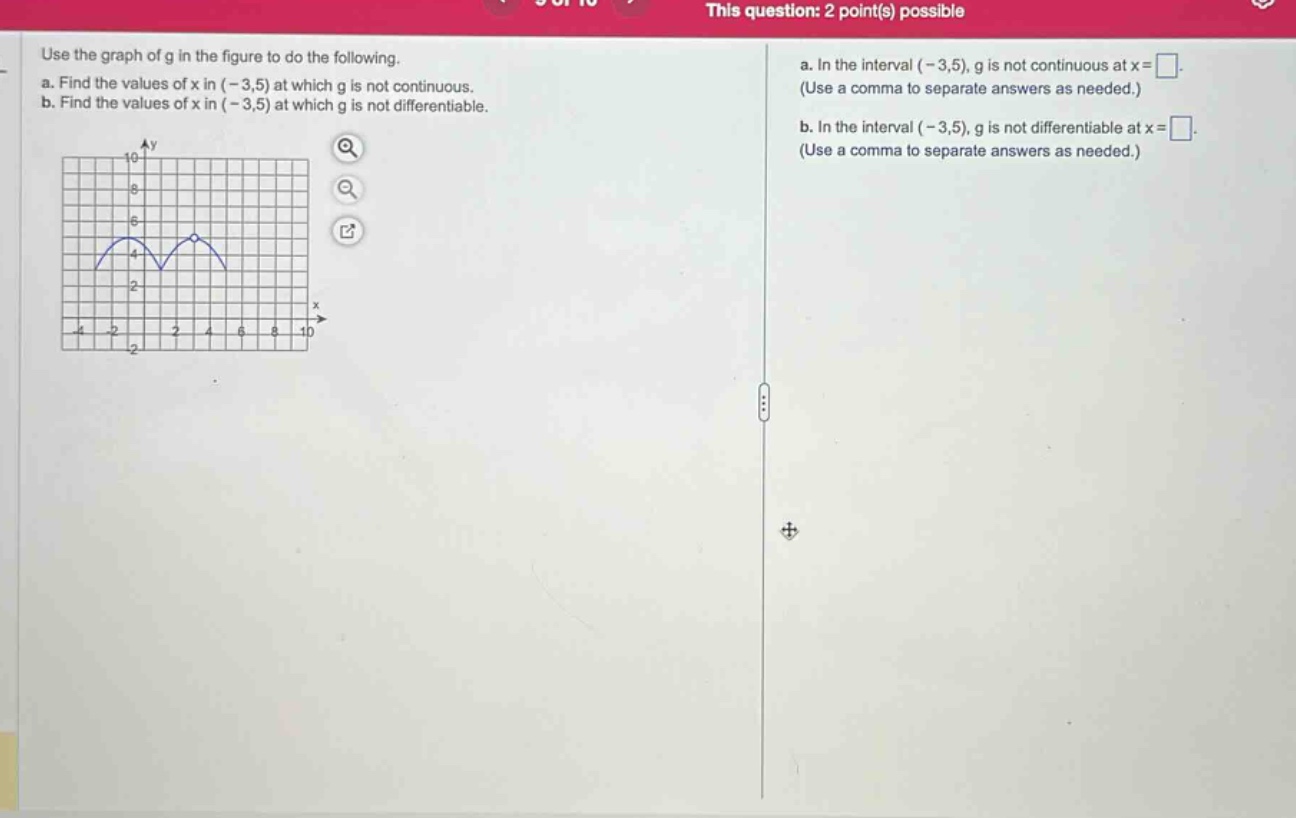
use the graph of g in the figure to do the following. a. find the values of x in (-3,5) at which g is not continuous. b. find the values of x in (-3,5) at which g is not differentiable. a. in the interval (-3,5), g is not continuous at x = (use a comma to separate answers as needed.) b. in the interval (-3,5), g is not differentiable at x = (use a comma to separate answers as needed.)
Answer
Explanation:
Step1: Recall continuity condition
A function is not - continuous at a point if there is a break, jump or hole in the graph. Looking at the graph of (y = g(x)) in the interval ((-3,5)), we check for such points. There are no visible breaks, jumps or holes in the given graph in the interval ((-3,5)), so the set of (x) - values for which (g) is not continuous is the empty - set.
Step2: Recall differentiability condition
A function is not differentiable at a point if there is a sharp corner, cusp, vertical tangent or a discontinuity at that point. In the graph of (y = g(x)) in the interval ((-3,5)), there are sharp corners. Let's assume the sharp - corner points occur at (x = 0) and (x = 4) (by observing the graph where the slope changes abruptly).
Answer:
a. b. (0,4)