use the graph of f in the figure to do the following. a. find the values of x in the interval (0,5) at which…
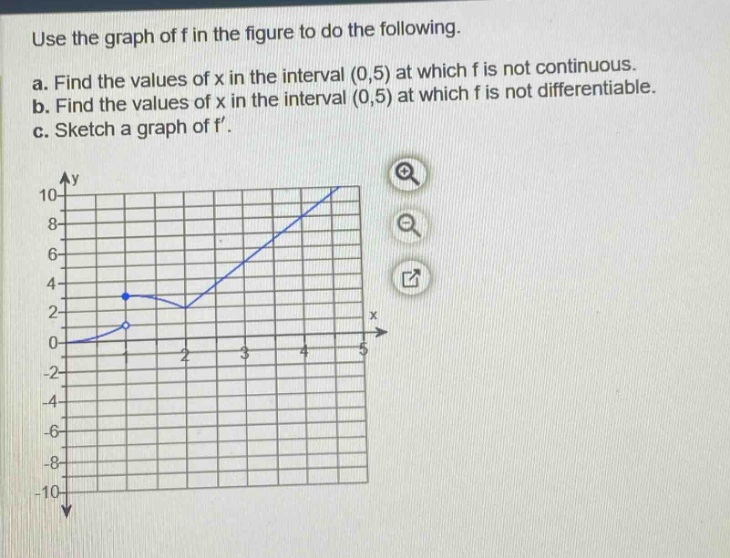
use the graph of f in the figure to do the following. a. find the values of x in the interval (0,5) at which f is not continuous. b. find the values of x in the interval (0,5) at which f is not differentiable. c. sketch a graph of f.
Answer
Answer:
a. The function (f) is not continuous at (x = 1) since there is a jump - discontinuity at (x=1). b. The function (f) is not differentiable at (x = 1) (due to the jump - discontinuity) and (x = 2) (due to the sharp corner). c.
- For (0<x<1), the function (f) is a linear function with a positive slope. Let's assume the line segment from ((0,0)) to ((1,2)) has a slope (m_1=\frac{2 - 0}{1-0}=2), so (f^{\prime}(x)=2) for (0 < x<1).
- At (x = 1), (f^{\prime}(x)) is undefined because of the discontinuity.
- For (1<x<2), the function (f) is decreasing. Let's assume the line segment from ((1,3)) to ((2,2)) has a slope (m_2=\frac{2 - 3}{2 - 1}=- 1), so (f^{\prime}(x)=-1) for (1<x<2).
- At (x = 2), (f^{\prime}(x)) is undefined because of the sharp - corner.
- For (2<x<5), the function (f) is a linear function with a positive slope. Let's assume the line segment from ((2,2)) to ((5,10)) has a slope (m_3=\frac{10 - 2}{5 - 2}=\frac{8}{3}), so (f^{\prime}(x)=\frac{8}{3}) for (2<x<5).
To sketch (y = f^{\prime}(x)):
- Draw a horizontal line (y = 2) for the open interval ((0,1)).
- There is a hole at (x = 1).
- Draw a horizontal line (y=-1) for the open interval ((1,2)).
- There is a hole at (x = 2).
- Draw a horizontal line (y=\frac{8}{3}\approx2.67) for the open interval ((2,5)).
Explanation:
Step1: Identify discontinuity for part a
Check for breaks in the graph. At (x = 1), there is a jump.
Step2: Identify non - differentiability for part b
Discontinuities and sharp corners make a function non - differentiable. (x = 1) (discontinuity) and (x = 2) (sharp corner).
Step3: Calculate slopes for part c (interval (0<x<1))
Use slope formula (m=\frac{y_2 - y_1}{x_2 - x_1}) for the line segment from ((0,0)) to ((1,2)), (m=\frac{2-0}{1 - 0}=2).
Step4: Note non - differentiability at (x = 1) for part c
Function is discontinuous, so derivative is undefined.
Step5: Calculate slopes for part c (interval (1<x<2))
Use slope formula for the line segment from ((1,3)) to ((2,2)), (m=\frac{2 - 3}{2 - 1}=-1).
Step6: Note non - differentiability at (x = 2) for part c
Function has a sharp corner, so derivative is undefined.
Step7: Calculate slopes for part c (interval (2<x<5))
Use slope formula for the line segment from ((2,2)) to ((5,10)), (m=\frac{10 - 2}{5 - 2}=\frac{8}{3}).
Step8: Sketch (y = f^{\prime}(x))
Draw horizontal lines for each non - undefined derivative interval with holes at non - differentiable points.