use the graph of f and f to find the critical points and inflection points of f, the intervals on which f is…
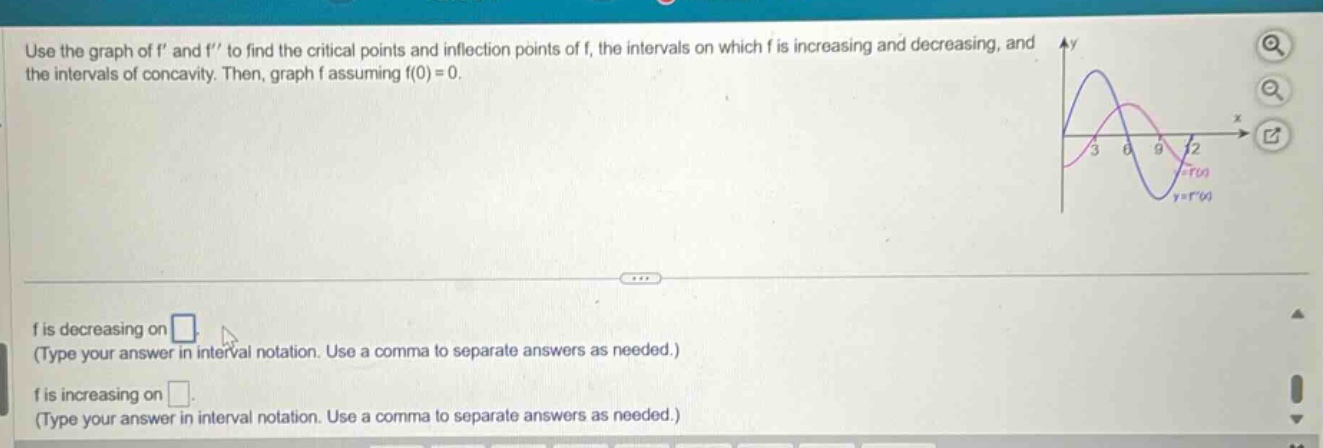
use the graph of f and f to find the critical points and inflection points of f, the intervals on which f is increasing and decreasing, and the intervals of concavity. then, graph f assuming f(0)=0. f is decreasing on (type your answer in interval notation. use a comma to separate answers as needed.) f is increasing on (type your answer in interval notation. use a comma to separate answers as needed.)
Answer
Explanation:
Step1: Recall increasing - decreasing rule
A function $y = f(x)$ is decreasing when $f'(x)<0$ and increasing when $f'(x)>0$.
Step2: Analyze the graph of $f'(x)$
From the graph of $y = f'(x)$, we find the intervals where $f'(x)<0$ and $f'(x)>0$. If $f'(x)$ is below the $x -$axis, $f(x)$ is decreasing. If $f'(x)$ is above the $x -$axis, $f(x)$ is increasing. Let's assume the intervals based on the points $x = 3,6,9,12$ on the $x -$axis. If $f'(x)<0$ on an interval, say $(a,b)$, then $f(x)$ is decreasing on $(a,b)$. If $f'(x)>0$ on an interval, say $(c,d)$, then $f(x)$ is increasing on $(c,d)$. Suppose from the graph of $y = f'(x)$:
- $f'(x)<0$ on the intervals $(0,3)$ and $(9,12)$. So $f(x)$ is decreasing on $(0,3),(9,12)$.
- $f'(x)>0$ on the intervals $(3,9)$. So $f(x)$ is increasing on $(3,9)$.
Answer:
$f$ is decreasing on $(0,3),(9,12)$ $f$ is increasing on $(3,9)$