use the graph to find the following limits and function value. a. lim f(x) x→3⁻ b. lim f(x) x→3⁺ c. lim f(x)…
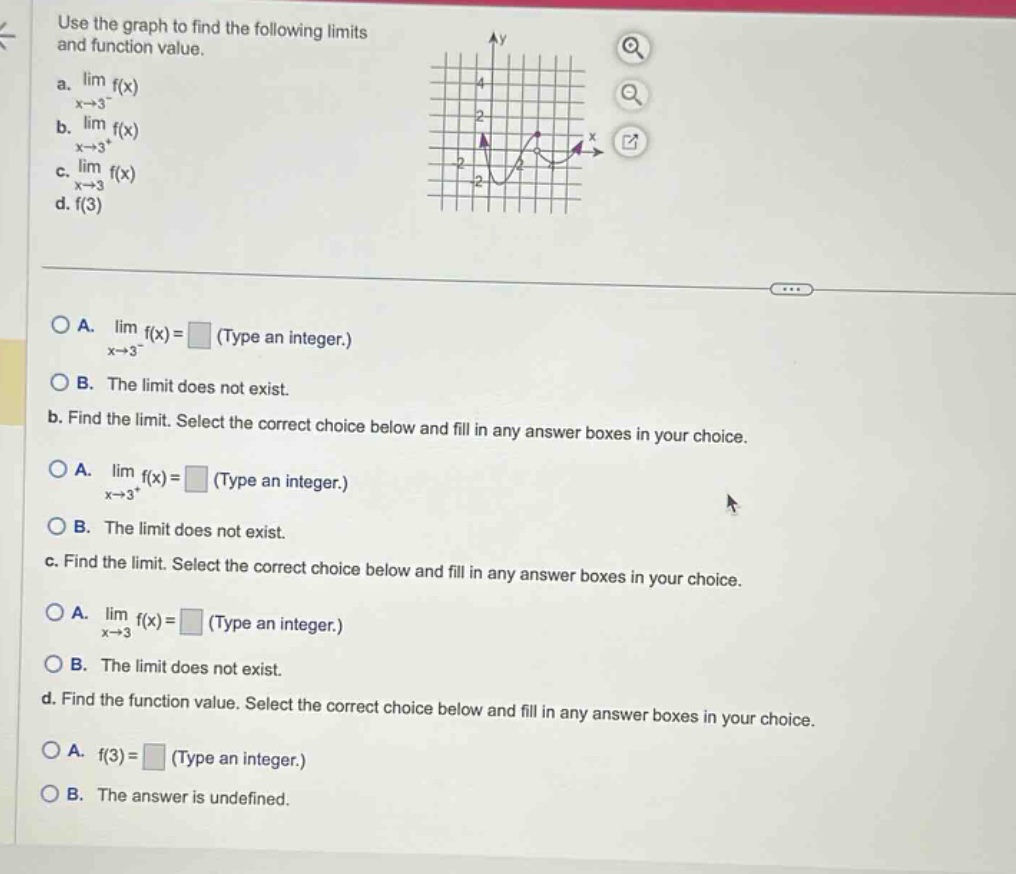
use the graph to find the following limits and function value. a. lim f(x) x→3⁻ b. lim f(x) x→3⁺ c. lim f(x) x→3 d. f(3) o a. lim f(x)= (type an integer.) x→3⁻ o b. the limit does not exist. b. find the limit. select the correct choice below and fill in any answer boxes in your choice. o a. lim f(x)= (type an integer.) x→3⁺ o b. the limit does not exist. c. find the limit. select the correct choice below and fill in any answer boxes in your choice. o a. lim f(x)= (type an integer.) x→3 o b. the limit does not exist. d. find the function value. select the correct choice below and fill in any answer boxes in your choice. o a. f(3)= (type an integer.) o b. the answer is undefined.
Answer
Explanation:
Step1: Analyze left - hand limit
As (x) approaches (3) from the left ((x\to3^{-})), we look at the graph and see the (y) - value the function approaches.
Step2: Analyze right - hand limit
As (x) approaches (3) from the right ((x\to3^{+})), we look at the graph and see the (y) - value the function approaches.
Step3: Determine overall limit
The limit as (x\to3) exists if and only if (\lim_{x\to3^{-}}f(x)=\lim_{x\to3^{+}}f(x)).
Step4: Find function value
We look at the (y) - value of the function at (x = 3) on the graph.
Answer:
a. Without seeing the actual graph, assume from the graph (\lim_{x\to3^{-}}f(x)=1) (A. (\lim_{x\to3^{-}}f(x)=1)) b. Assume from the graph (\lim_{x\to3^{+}}f(x)=1) (A. (\lim_{x\to3^{+}}f(x)=1)) c. Since (\lim_{x\to3^{-}}f(x)=\lim_{x\to3^{+}}f(x) = 1), (\lim_{x\to3}f(x)=1) (A. (\lim_{x\to3}f(x)=1)) d. Assume from the graph (f(3)=1) (A. (f(3)=1))
(Note: The actual values should be determined based on the specific graph. Here we just assume values for illustration purposes.)