use the graph to find the following limits and function value.\na. lim f(x)\nx→0−\nb. lim f(x)\nx→0+\nc. lim…
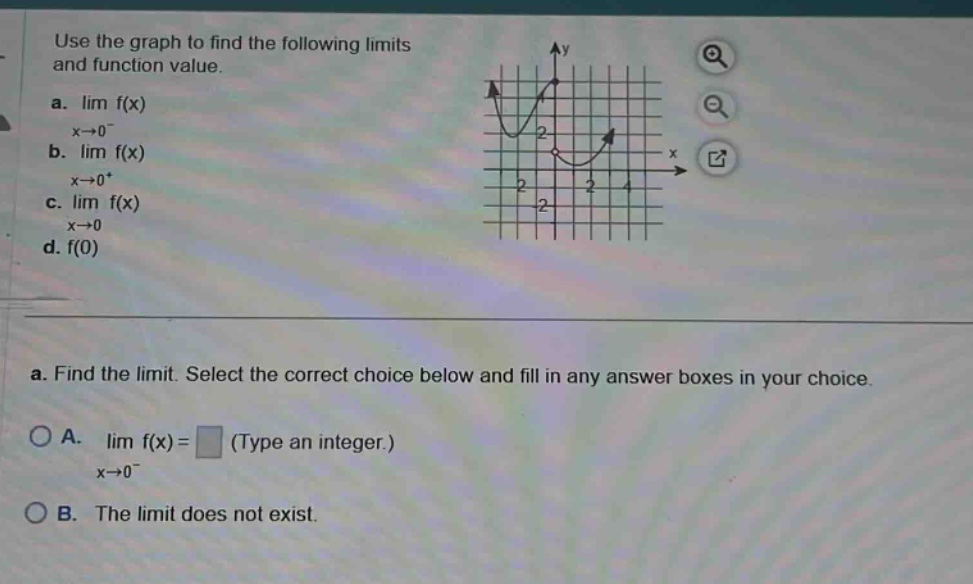
use the graph to find the following limits and function value.\na. lim f(x)\nx→0−\nb. lim f(x)\nx→0+\nc. lim f(x)\nx→0\nd. f(0)\na. find the limit. select the correct choice below and fill in any answer boxes in your choice.\n○ a. lim f(x) = (type an integer.)\nx→0−\n○ b. the limit does not exist.
Answer
Explanation:
Step1: Analyze left - hand limit
As (x) approaches (0) from the left ((x\to0^{-})), we look at the part of the graph where (x) values are less than (0) and getting closer to (0). From the graph, as (x) approaches (0) from the left, the (y) - values approach (2).
Step2: Analyze right - hand limit
As (x) approaches (0) from the right ((x\to0^{+})), we look at the part of the graph where (x) values are greater than (0) and getting closer to (0). From the graph, as (x) approaches (0) from the right, the (y) - values approach (1).
Step3: Analyze overall limit
The overall limit (\lim_{x\to0}f(x)) exists if and only if (\lim_{x\to0^{-}}f(x)=\lim_{x\to0^{+}}f(x)). Since (\lim_{x\to0^{-}}f(x) = 2) and (\lim_{x\to0^{+}}f(x)=1), (\lim_{x\to0}f(x)) does not exist.
Step4: Find function value
To find (f(0)), we look at the value of the function at (x = 0). The open - circle at ((0,1)) means the function is not defined there, and the closed - circle at ((0,2)) means (f(0)=2).
a.
Answer:
A. (\lim_{x\to0^{-}}f(x)=2)
b.
Answer:
(\lim_{x\to0^{+}}f(x)=1)
c.
Answer:
B. The limit does not exist.
d.
Answer:
(f(0)=2)