use the graph to find the following limits and function value. a. lim f(x) x→0⁻ b. lim f(x) x→0⁺ c. lim f(x)…
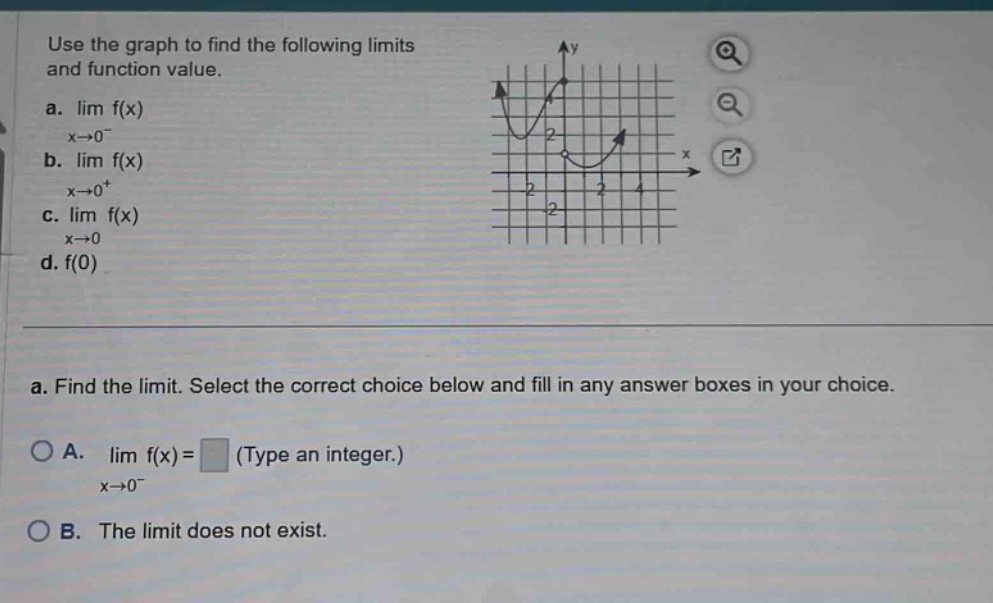
use the graph to find the following limits and function value. a. lim f(x) x→0⁻ b. lim f(x) x→0⁺ c. lim f(x) x→0 d. f(0) a. find the limit. select the correct choice below and fill in any answer boxes in your choice. a. lim f(x)= (type an integer.) x→0⁻ b. the limit does not exist.
Answer
Explanation:
Step1: Analyze left - hand limit
As (x) approaches (0) from the left ((x\to0^{-})), we look at the part of the graph where (x) values are less than (0) and getting closer to (0). By observing the graph, the (y) - values approach (4).
Step2: Analyze right - hand limit
As (x) approaches (0) from the right ((x\to0^{+})), we look at the part of the graph where (x) values are greater than (0) and getting closer to (0). By observing the graph, the (y) - values approach (1).
Step3: Analyze overall limit
The overall limit (\lim_{x\to0}f(x)) exists if and only if (\lim_{x\to0^{-}}f(x)=\lim_{x\to0^{+}}f(x)). Since (4\neq1), (\lim_{x\to0}f(x)) does not exist.
Step4: Find function value
To find (f(0)), we look at the value of the function at (x = 0). The open - circle at (x = 0) means the function is not defined at that point in the way the graph is drawn. But if we assume the function is defined as the value of the closed - circle (a common convention for piece - wise defined functions), we need to observe the graph. However, the problem doesn't clearly define (f(0)) based on the graph's notation. But for the left - hand limit:
Answer:
a. A. (\lim_{x\to0^{-}}f(x)=4) b. (\lim_{x\to0^{+}}f(x)=1) c. B. The limit does not exist. d. The value of (f(0)) is not clearly defined from the given graph.