use the graph of f to find the indicated limit and function value a. lim f(x) b. f(-4) x→ - 4 a. select the…
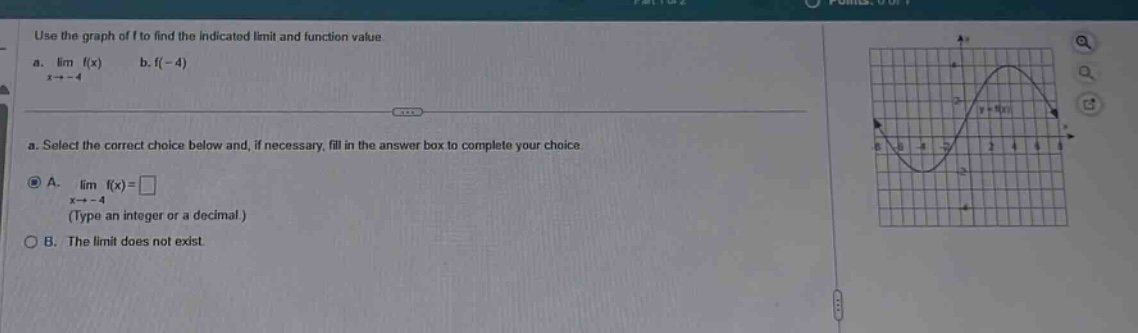
use the graph of f to find the indicated limit and function value a. lim f(x) b. f(-4) x→ - 4 a. select the correct choice below and, if necessary, fill in the answer box to complete your choice. a. lim f(x)=□ x→ - 4 (type an integer or a decimal.) b. the limit does not exist
Answer
Explanation:
Step1: Analyze left - hand limit
As (x) approaches (- 4) from the left side on the graph, observe the (y) - value the function approaches.
Step2: Analyze right - hand limit
As (x) approaches (- 4) from the right side on the graph, observe the (y) - value the function approaches. If the left - hand limit and right - hand limit are equal, that value is the limit as (x\to - 4).
Step3: Find function value
To find (f(-4)), look at the (y) - value of the function at (x = - 4) on the graph.
Since we don't have the actual graph to perform the visual analysis and get the numerical values, we can't give a specific numerical answer for part a and part b. But the general process for finding (\lim_{x\to - 4}f(x)) is to check the left - hand and right - hand limits as described above, and for (f(-4)) we just look at the value of the function at (x=-4) on the graph.
If we assume we have done the visual analysis on the graph: Let's say after looking at the graph, the left - hand limit as (x\to - 4) and right - hand limit as (x\to - 4) are both equal to (L).
Answer:
a. A. (\lim_{x\to - 4}f(x)=L) (where (L) is the value obtained from the graph) b. (f(-4)) is the (y) - value of the function at (x = - 4) on the graph (a specific number if the function is defined at (x=-4))