use the graph of f to find the largest open interval on which f is increasing, and the largest open interval…
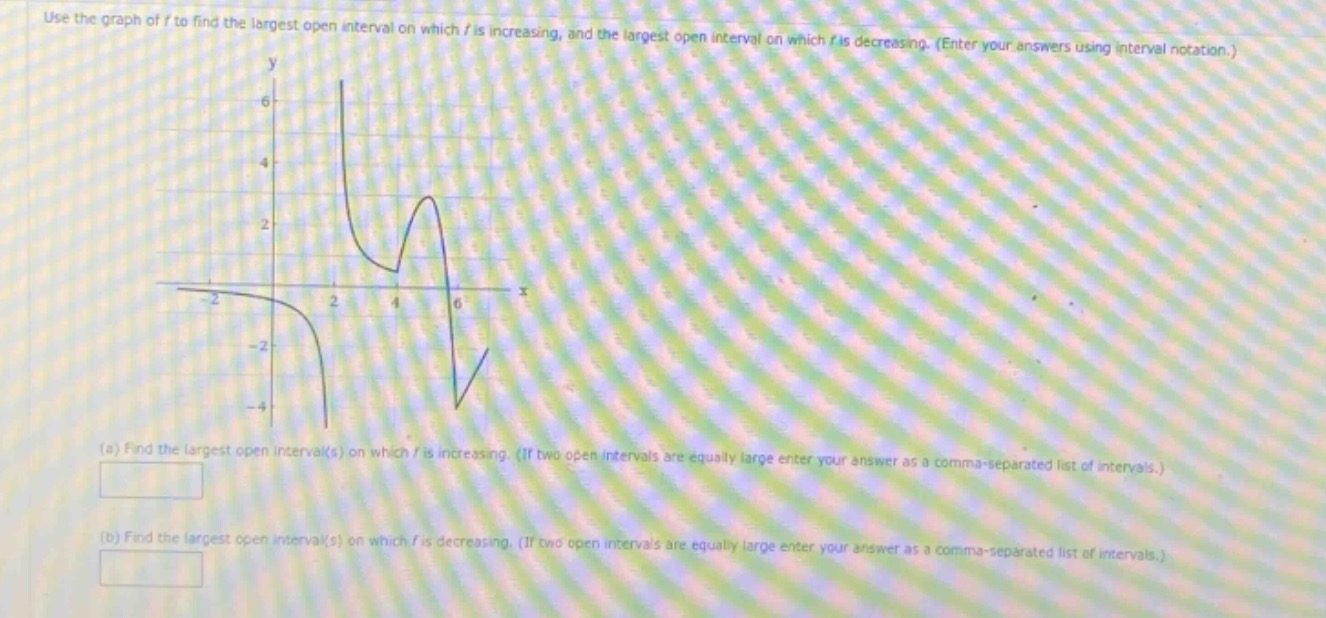
use the graph of f to find the largest open interval on which f is increasing, and the largest open interval on which f is decreasing. (enter your answers using interval notation.) (a) find the largest open interval(s) on which f is increasing. (if two open intervals are equally large enter your answer as a comma - separated list of intervals.) (b) find the largest open interval(s) on which f is decreasing. (if two open intervals are equally large enter your answer as a comma - separated list of intervals.)
Answer
Explanation:
Step1: Recall increasing - decreasing function concept
A function (y = f(x)) is increasing on an interval if for any two points (x_1) and (x_2) in the interval with (x_1<x_2), (f(x_1)<f(x_2)), and decreasing if (f(x_1)>f(x_2)).
Step2: Analyze the graph for increasing intervals
Looking at the graph, we see that the function is increasing on the intervals ((3,5)). There are no other larger non - overlapping increasing intervals.
Step3: Analyze the graph for decreasing intervals
The function is decreasing on the intervals ((-\infty,2)) and ((5,\infty)). The larger of these two non - overlapping decreasing intervals is ((-\infty,2)).
Answer:
(a) ((3,5)) (b) ((-\infty,2))