use the graph to find:\n(a) the numbers, if any, at which f has a local maximum. what are these local…
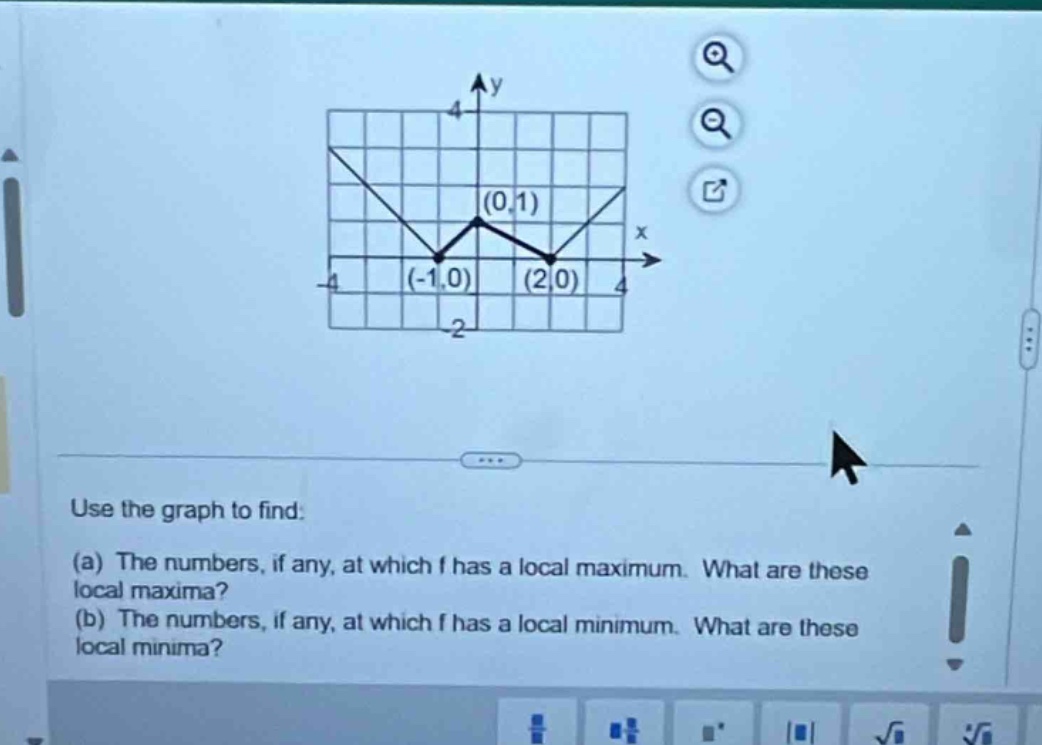
use the graph to find:\n(a) the numbers, if any, at which f has a local maximum. what are these local maxima?\n(b) the numbers, if any, at which f has a local minimum. what are these local minima?
Answer
Explanation:
Step1: Recall local - maximum definition
A function (y = f(x)) has a local maximum at (x = c) if (f(c)\geq f(x)) for all (x) in some open interval containing (c).
Step2: Analyze the graph
Looking at the graph, at (x = 0), the function value (f(0)=1) is greater than the function values of the points in the immediate neighborhood of (x = 0). So the number at which (f) has a local maximum is (x = 0), and the local - maximum value is (f(0)=1).
Step3: Recall local - minimum definition
A function (y = f(x)) has a local minimum at (x = c) if (f(c)\leq f(x)) for all (x) in some open interval containing (c).
Step4: Analyze the graph for local minima
The function has local minima at (x=-1) and (x = 2) since (f(-1)=0) and (f(2)=0) and these values are less than the function values of the points in their immediate neighborhoods.
Answer:
(a) The number at which (f) has a local maximum is (x = 0), and the local - maximum is (1). (b) The numbers at which (f) has local minima are (x=-1) and (x = 2), and the local - minima are (0) (for both (x=-1) and (x = 2)).