use a graph to (a) find the range, (b) give the largest open interval over which the function is increasing…
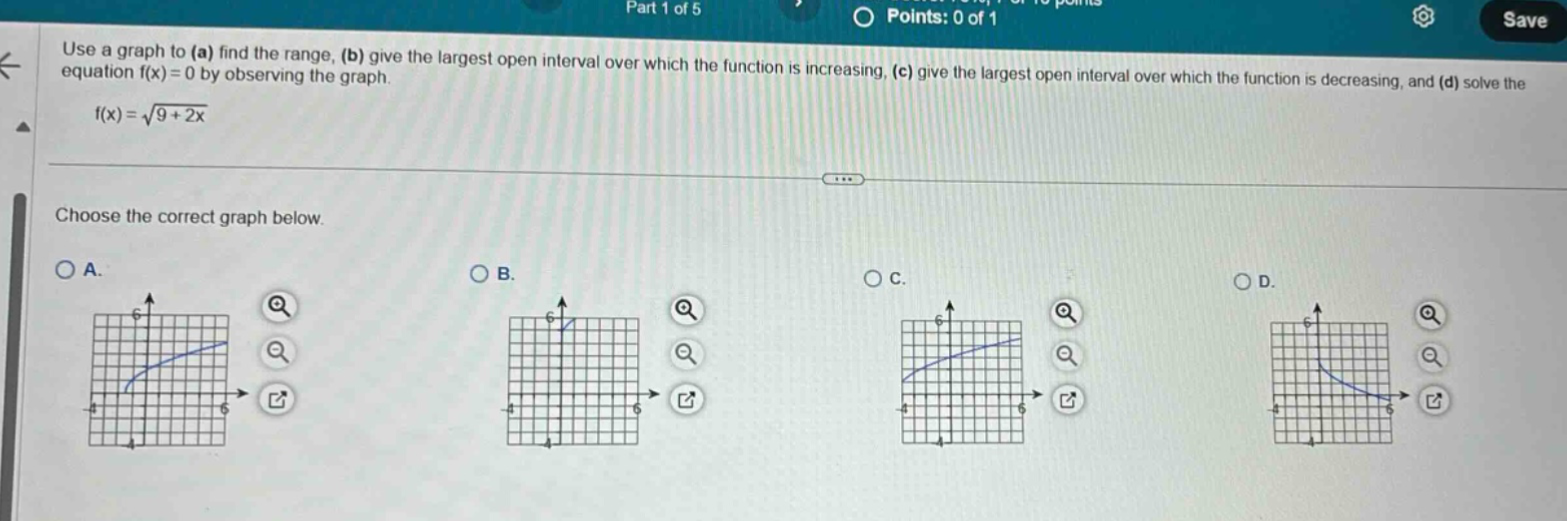
use a graph to (a) find the range, (b) give the largest open interval over which the function is increasing, (c) give the largest open interval over which the function is decreasing, and (d) solve the equation f(x)=0 by observing the graph. f(x)=√(9 + 2x) choose the correct graph below. a. b. c. d.
Answer
Explanation:
Step1: Determine domain of the function
For $f(x)=\sqrt{9 + 2x}$, the expression under the square - root must be non - negative. So, $9+2x\geq0$, which gives $x\geq-\frac{9}{2}$.
Step2: Analyze the range
Since the square - root function $\sqrt{u}$ has a range of $y\geq0$ when $u\geq0$. Here $u = 9 + 2x\geq0$, so the range of $f(x)=\sqrt{9 + 2x}$ is $y\geq0$.
Step3: Analyze increasing and decreasing intervals
The derivative of $y=\sqrt{9 + 2x}=(9 + 2x)^{\frac{1}{2}}$ using the chain rule: $y^\prime=\frac{1}{2}(9 + 2x)^{-\frac{1}{2}}\times2=\frac{1}{\sqrt{9 + 2x}}$. Since $y^\prime>0$ for all $x>-\frac{9}{2}$, the function is increasing on the interval $(-\frac{9}{2},\infty)$ and there is no interval where it is decreasing.
Step4: Solve $f(x)=0$
Set $\sqrt{9 + 2x}=0$. Squaring both sides gives $9 + 2x = 0$, so $x=-\frac{9}{2}$.
Answer:
a. Range: $[0,\infty)$ b. Increasing interval: $(-\frac{9}{2},\infty)$ c. Decreasing interval: None d. Solution of $f(x) = 0$: $x=-\frac{9}{2}$