use the graph of the function y = f(x) below to answer the questions.\n(a) is f(5) positive?\nyes no\n(b)…
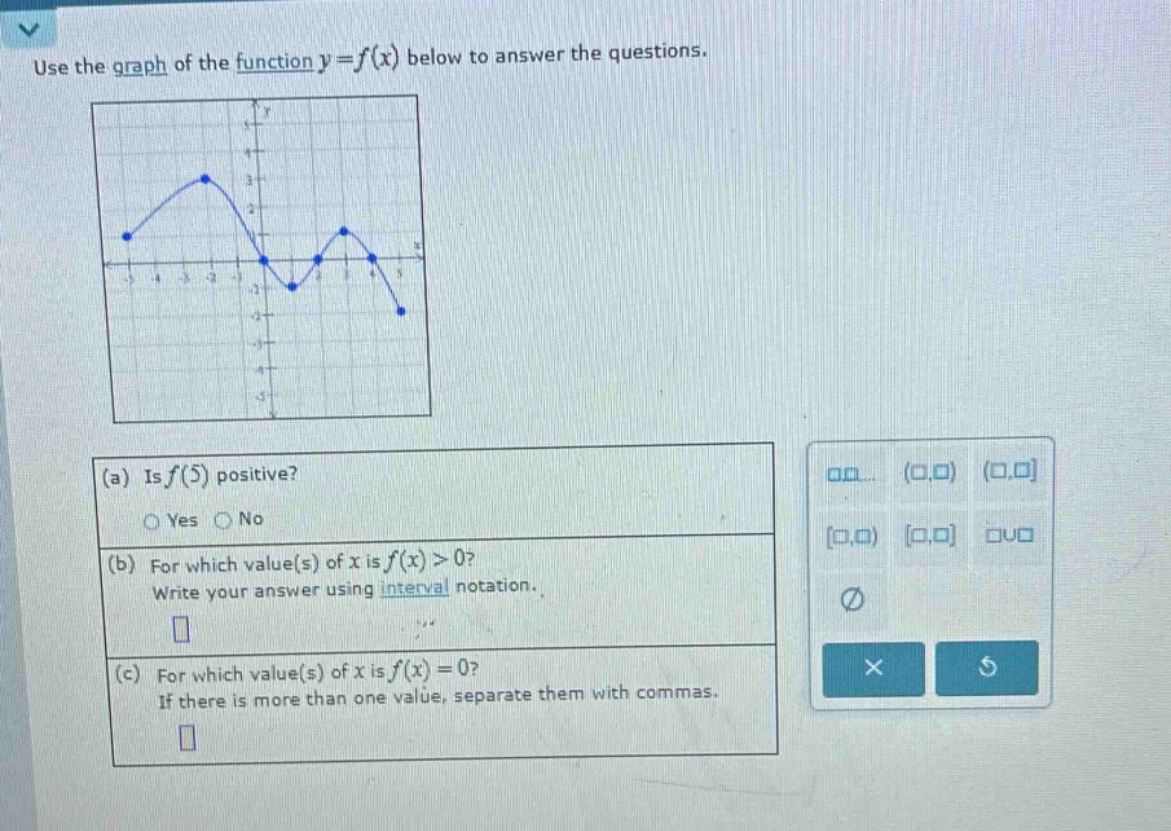
use the graph of the function y = f(x) below to answer the questions.\n(a) is f(5) positive?\nyes no\n(b) for which value(s) of x is f(x)>0?\nwrite your answer using interval notation.\n(c) for which value(s) of x is f(x)=0?\nif there is more than one value, separate them with commas.
Answer
Explanation:
Step1: Locate x = 5 on graph
Find the point on the x - axis where x = 5 and see the corresponding y - value.
Step2: Determine sign of f(5)
The y - value at x = 5 is negative, so f(5) is not positive.
Step3: Find x for f(x)>0
Identify the x - intervals where the graph is above the x - axis.
Step4: Write in interval notation
The graph is above the x - axis for - 5<x<-1 and 2<x<4, so the interval is (-5,-1)\cup(2,4).
Step5: Find x for f(x)=0
Locate the x - values where the graph intersects the x - axis.
Step6: List x - values
The graph intersects the x - axis at x=-1, x = 2, x = 4, so the values are - 1,2,4.
Answer:
(a) No (b) (-5,-1)\cup(2,4) (c) - 1,2,4