use the graph of a function y = f(x) to find the absolute maximum and the absolute minimum, if they exist…
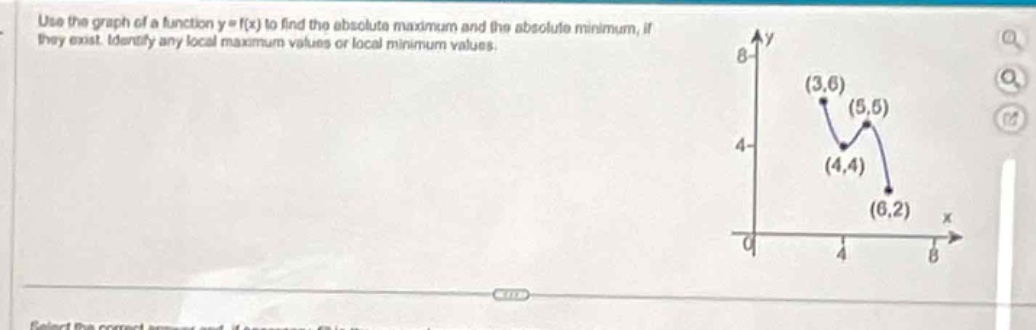
use the graph of a function y = f(x) to find the absolute maximum and the absolute minimum, if they exist. identify any local maximum values or local minimum values.
Answer
Explanation:
Step1: Define absolute maximum
The absolute maximum of a function on an interval is the largest - valued output of the function on that interval. Looking at the points ((3,6)), ((4,4)), ((5,5)), and ((6,2)), the (y) - value of (6) at (x = 3) is the largest.
Step2: Define absolute minimum
The absolute minimum of a function on an interval is the smallest - valued output of the function on that interval. Among the points ((3,6)), ((4,4)), ((5,5)), and ((6,2)), the (y) - value of (2) at (x = 6) is the smallest.
Step3: Define local maximum
A local maximum occurs at a point where the function changes from increasing to decreasing. At (x = 3), the function changes from increasing (before (x = 3)) to decreasing (after (x = 3)), so (y=6) at (x = 3) is a local maximum. Also, at (x = 5), the function changes from increasing (before (x = 5)) to decreasing (after (x = 5)), so (y = 5) at (x = 5) is a local maximum.
Step4: Define local minimum
A local minimum occurs at a point where the function changes from decreasing to increasing. At (x = 4), the function changes from decreasing (before (x = 4)) to increasing (after (x = 4)), so (y = 4) at (x = 4) is a local minimum.
Answer:
Absolute maximum: (y = 6) at (x = 3) Absolute minimum: (y = 2) at (x = 6) Local maximum values: (y = 6) at (x = 3) and (y = 5) at (x = 5) Local minimum value: (y = 4) at (x = 4)