use the graph and the function to find the following.\na) find $lim_{x\rightarrow - 1}k(x)$.\nb) find…
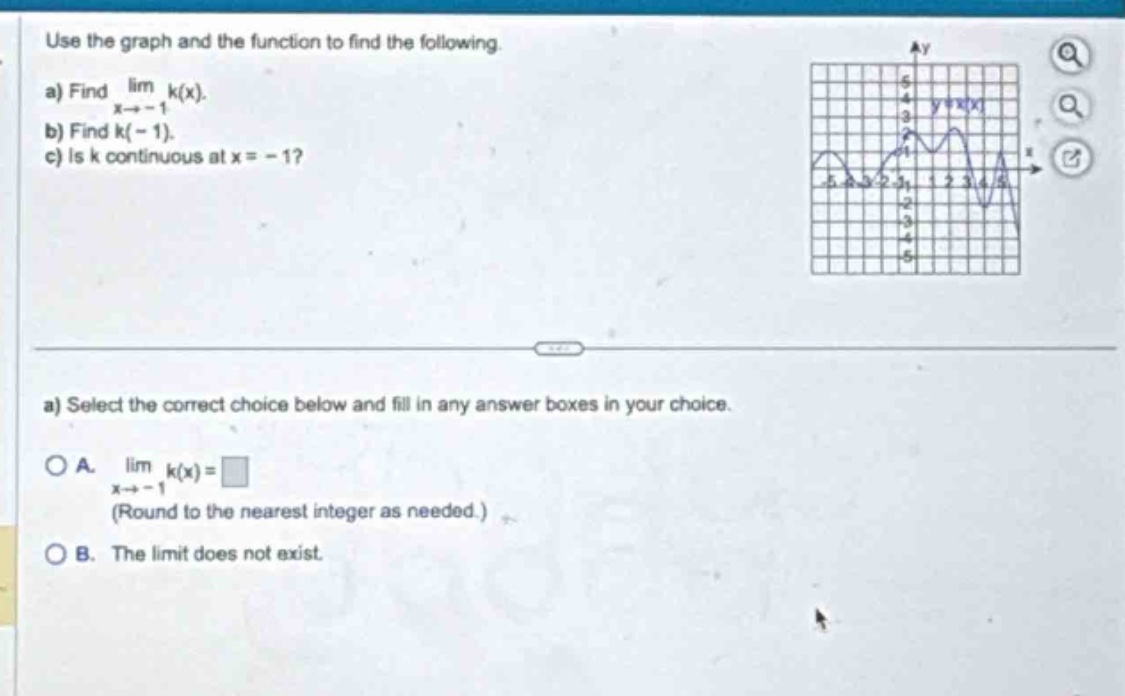
use the graph and the function to find the following.\na) find $lim_{x\rightarrow - 1}k(x)$.\nb) find $k(-1)$.\nc) is $k$ continuous at $x = - 1$?\na) select the correct choice below and fill in any answer boxes in your choice.\na. $lim_{x\rightarrow - 1}k(x)=square$ (round to the nearest integer as needed.)\nb. the limit does not exist.
Answer
Explanation:
Step1: Analyze left - hand limit
As (x) approaches (- 1) from the left side ((x\to - 1^{-})), observe the (y) - values of the graph of (y = k(x)).
Step2: Analyze right - hand limit
As (x) approaches (- 1) from the right side ((x\to - 1^{+})), observe the (y) - values of the graph of (y = k(x)). If the left - hand limit and the right - hand limit are equal, then (\lim_{x\to - 1}k(x)) exists and is equal to that common value.
Step3: Find (k(-1))
Locate the point on the graph where (x=-1) to find the value of (k(-1)).
Step4: Check continuity
A function (y = k(x)) is continuous at (x = a) if (\lim_{x\to a}k(x)=k(a)). Check if (\lim_{x\to - 1}k(x)=k(-1)) based on the previous results.
Answer:
Since we don't have the actual graph to perform the visual analysis: a) Without seeing the graph, we cannot determine if (\lim_{x\to - 1}k(x)) exists or its value. If the left - hand and right - hand limits as (x\to - 1) are equal, we choose A and fill in the value, otherwise we choose B. b) Without the graph, we cannot find (k(-1)). c) Without the values of (\lim_{x\to - 1}k(x)) and (k(-1)) from the graph, we cannot determine if (k) is continuous at (x=-1).