use the graph of the function f shown to estimate the following limits and the function value. complete…
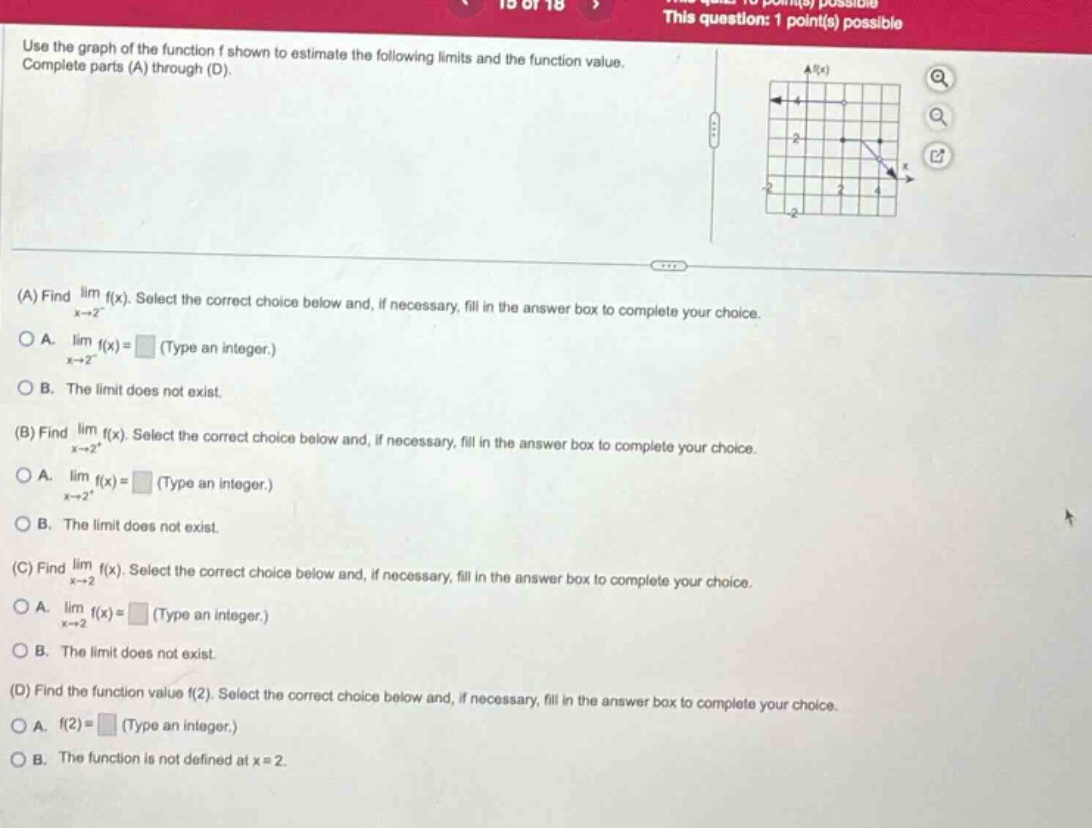
use the graph of the function f shown to estimate the following limits and the function value. complete parts (a) through (d). (a) find lim f(x). select the correct choice below and, if necessary, fill in the answer box to complete your choice. x→2⁻ a. lim f(x)= (type an integer.) x→2⁻ b. the limit does not exist. (b) find lim f(x). select the correct choice below and, if necessary, fill in the answer box to complete your choice. x→2⁺ a. lim f(x)= (type an integer.) x→2⁺ b. the limit does not exist. (c) find lim f(x). select the correct choice below and, if necessary, fill in the answer box to complete your choice. x→2 a. lim f(x)= (type an integer.) x→2 b. the limit does not exist. (d) find the function value f(2). select the correct choice below and, if necessary, fill in the answer box to complete your choice. a. f(2)= (type an integer.) b. the function is not defined at x = 2.
Answer
Explanation:
Step1: Analyze left - hand limit as x→2⁻
As x approaches 2 from the left side (x→2⁻), we look at the part of the graph to the left of x = 2. The y - value approaches 4. So, $\lim_{x\rightarrow2^{-}}f(x)=4$.
Step2: Analyze right - hand limit as x→2⁺
As x approaches 2 from the right side (x→2⁺), we look at the part of the graph to the right of x = 2. The y - value approaches 1. So, $\lim_{x\rightarrow2^{+}}f(x)=1$.
Step3: Analyze overall limit as x→2
Since $\lim_{x\rightarrow2^{-}}f(x)=4$ and $\lim_{x\rightarrow2^{+}}f(x)=1$, and $4\neq1$, the overall limit $\lim_{x\rightarrow2}f(x)$ does not exist.
Step4: Analyze function value at x = 2
The graph has an open - circle at x = 2, which means the function is not defined at x = 2.
Answer:
(A) A. $\lim_{x\rightarrow2^{-}}f(x)=4$ (B) A. $\lim_{x\rightarrow2^{+}}f(x)=1$ (C) B. The limit does not exist. (D) B. The function is not defined at x = 2.