use the graph of the given function to find any relative maxima and relative minima. f(x)=x^3 - 3x^2 + 1
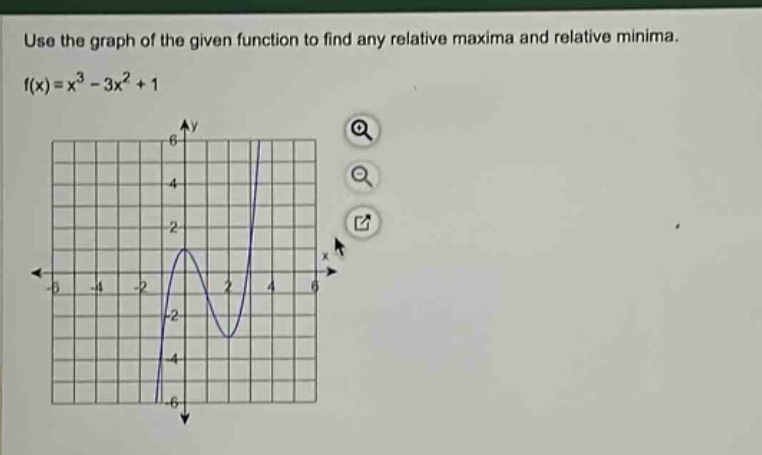
use the graph of the given function to find any relative maxima and relative minima. f(x)=x^3 - 3x^2 + 1
Answer
Explanation:
Step1: Find the derivative
The derivative of $f(x)=x^{3}-3x^{2}+1$ is $f'(x)=3x^{2}-6x = 3x(x - 2)$.
Step2: Find critical points
Set $f'(x)=0$. So $3x(x - 2)=0$. Solving gives $x = 0$ and $x=2$.
Step3: Use the first - derivative test
Choose test points in the intervals $(-\infty,0)$, $(0,2)$ and $(2,\infty)$. For the interval $(-\infty,0)$, let $x=-1$. Then $f'(-1)=3\times(-1)\times(-1 - 2)=9>0$, so $f(x)$ is increasing on $(-\infty,0)$. For the interval $(0,2)$, let $x = 1$. Then $f'(1)=3\times1\times(1 - 2)=-3<0$, so $f(x)$ is decreasing on $(0,2)$. For the interval $(2,\infty)$, let $x = 3$. Then $f'(3)=3\times3\times(3 - 2)=9>0$, so $f(x)$ is increasing on $(2,\infty)$. Since $f(x)$ changes from increasing to decreasing at $x = 0$, $f(0)=0^{3}-3\times0^{2}+1 = 1$ is a relative maximum. Since $f(x)$ changes from decreasing to increasing at $x = 2$, $f(2)=2^{3}-3\times2^{2}+1=8 - 12 + 1=-3$ is a relative minimum.
Answer:
Relative maximum: $(0,1)$; Relative minimum: $(2,-3)$