use the graph shown to find the following.\n(a) the domain and range of the function\n(b) the intercepts, if…
use the graph shown to find the following.\n(a) the domain and range of the function\n(b) the intercepts, if any\n(c) horizontal asymptotes, if any\n(d) vertical asymptotes, if any\n(e) oblique asymptotes, if any
Answer
Explanation:
Step1: Determine the domain
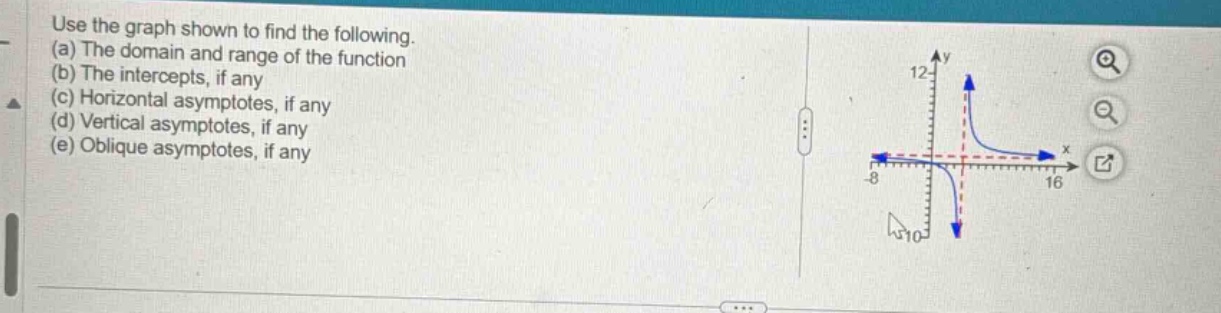
The domain is the set of all x - values for which the function is defined. Looking at the graph, the function is defined for all real x - values except x = 0. So the domain is $(-\infty,0)\cup(0,\infty)$.
Step2: Determine the range
The range is the set of all y - values that the function takes. From the graph, the function takes all real y - values except y = 0. So the range is $(-\infty,0)\cup(0,\infty)$.
Step3: Find the intercepts
To find the x - intercept, we set y = 0. From the graph, the function never crosses the x - axis, so there is no x - intercept. To find the y - intercept, we set x = 0, but the function is not defined at x = 0, so there is no y - intercept.
Step4: Find horizontal asymptotes
As $x\to\pm\infty$, the function approaches y = 0. So the horizontal asymptote is y = 0.
Step5: Find vertical asymptotes
The function is not defined at x = 0 and as $x\to0^{+}$ and $x\to0^{-}$, the function goes to $\pm\infty$. So the vertical asymptote is x = 0.
Step6: Find oblique asymptotes
Since the degree of the numerator is less than the degree of the denominator (assuming the function is a rational function based on the shape of the graph), there are no oblique asymptotes.
Answer:
(a) Domain: $(-\infty,0)\cup(0,\infty)$ (b) Intercepts: None (c) Horizontal asymptote: y = 0 (d) Vertical asymptote: x = 0 (e) Oblique asymptote: None