use the graph shown to find the following. (a) the domain and range of the function (b) the intercepts, if…
use the graph shown to find the following. (a) the domain and range of the function (b) the intercepts, if any (c) horizontal asymptotes, if any (d) vertical asymptotes, if any (e) oblique asymptotes, if any
Answer
Explanation:
Step1: Determine domain
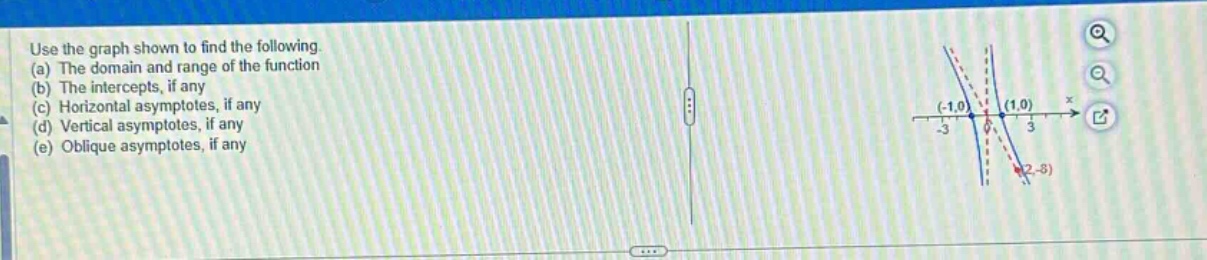
The function is defined for all real - x values except where the denominator is zero. From the graph, there are no breaks in the x - direction that would limit the domain. So the domain is all real numbers, $(-\infty,\infty)$.
Step2: Determine range
The graph has no upper or lower bounds. The function can take on any real - y value. So the range is all real numbers, $(-\infty,\infty)$.
Step3: Find x - intercepts
The x - intercepts are the points where the graph crosses the x - axis. From the graph, the x - intercepts are $x=-1$ and $x = 1$.
Step4: Find y - intercepts
The y - intercept is the point where the graph crosses the y - axis. Since the graph is symmetric about the origin and passes through $(-1,0)$ and $(1,0)$, when $x = 0$, the function value is $y = 0$. So the y - intercept is $y = 0$.
Step5: Check horizontal asymptotes
As $x\to\pm\infty$, the function does not approach a constant value. So there are no horizontal asymptotes.
Step6: Check vertical asymptotes
The graph does not have any vertical lines where the function approaches $\pm\infty$. So there are no vertical asymptotes.
Step7: Check oblique asymptotes
As $x\to\pm\infty$, the function does not approach a non - horizontal, non - vertical line. So there are no oblique asymptotes.
Answer:
(a) Domain: $(-\infty,\infty)$; Range: $(-\infty,\infty)$ (b) x - intercepts: $x=-1,x = 1$; y - intercept: $y = 0$ (c) None (d) None (e) None