use the graph shown to find the following. (a) the domain and range of the function (b) the intercepts, if…
use the graph shown to find the following. (a) the domain and range of the function (b) the intercepts, if any (c) horizontal asymptotes, if any (d) vertical asymptotes, if any (e) oblique asymptotes, if any (a) the domain of the function is . (type your answer in interval notation. use integers or fractions for any numbers in the expression.)
Answer
Explanation:
Step1: Identify domain from graph
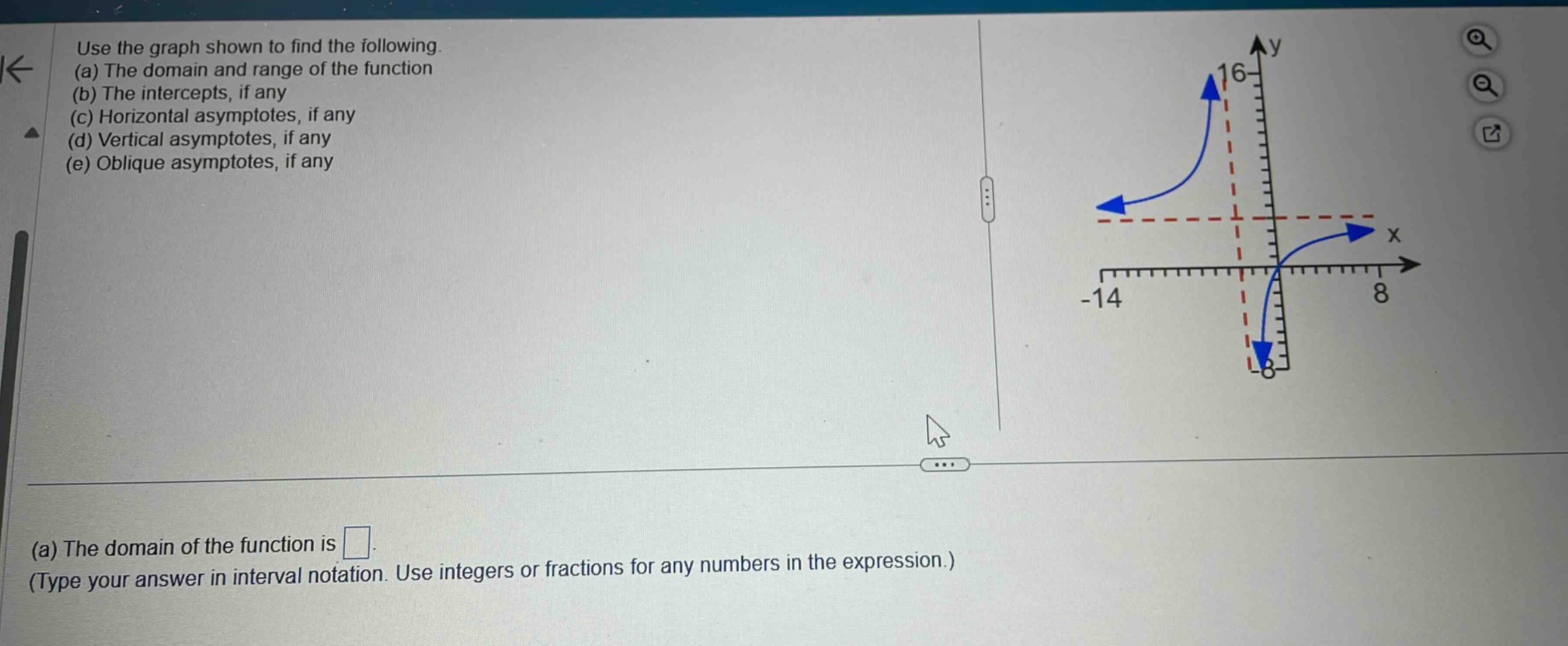
The function exists for all real - x values except where there is a vertical asymptote. The vertical asymptote is at x = - 6. So the domain is all real numbers except x=-6. $(-\infty,-6)\cup(-6,\infty)$
Step2: Identify range from graph
The function exists for all real - y values except where there is a horizontal asymptote. The horizontal asymptote is at y = 2. So the range is all real numbers except y = 2. $(-\infty,2)\cup(2,\infty)$
Step3: Find x - intercept
The graph crosses the x - axis at x = 0. So the x - intercept is 0.
Step4: Find y - intercept
The graph crosses the y - axis at y = 0. So the y - intercept is 0.
Step5: Identify horizontal asymptote
As x approaches positive or negative infinity, the function approaches y = 2. So the horizontal asymptote is y = 2.
Step6: Identify vertical asymptote
The function has a break at x=-6, and the graph approaches infinity or negative infinity as x approaches - 6. So the vertical asymptote is x=-6.
Step7: Identify oblique asymptote
Since the degree of the numerator is not one more than the degree of the denominator (from the behavior of the graph indicating a rational - like function), there is no oblique asymptote.
Answer:
(a) Domain: $(-\infty,-6)\cup(-6,\infty)$ (b) Intercepts: x - intercept: 0, y - intercept: 0 (c) Horizontal asymptote: y = 2 (d) Vertical asymptote: x=-6 (e) Oblique asymptote: None