use the graph shown to find the following. (a) the domain and range of the function (b) the intercepts, if…
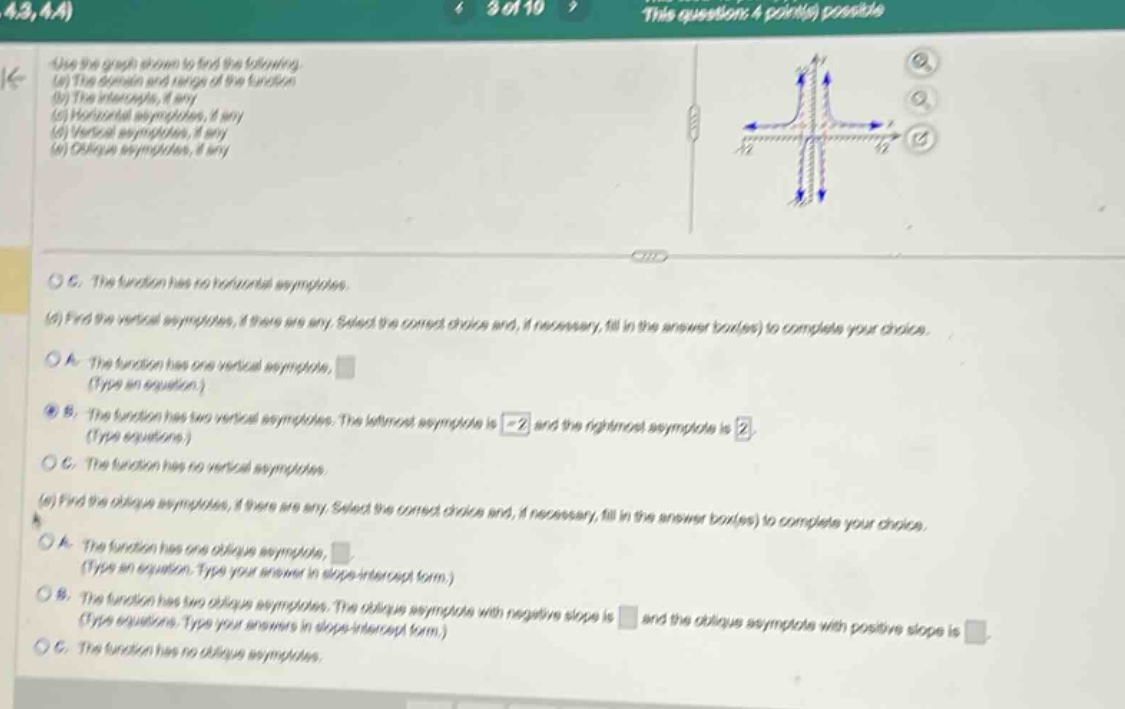
use the graph shown to find the following. (a) the domain and range of the function (b) the intercepts, if any (c) horizontal asymptotes, if any (d) vertical asymptotes, if any (e) oblique asymptotes, if any c. the function has no horizontal asymptotes. (d) find the vertical asymptotes, if there are any. select the correct choice and, if necessary, fill in the answer box(es) to complete your choice. a. the function has one vertical asymptote, (type an equation.) b. the function has two vertical asymptotes. the left - most asymptote is - 2 and the right - most asymptote is 2. (type equations.) c. the function has no vertical asymptotes. (e) find the oblique asymptotes, if there are any. select the correct choice and, if necessary, fill in the answer box(es) to complete your choice. a. the function has one oblique asymptote, (type an equation. type your answer in slope - intercept form.) b. the function has two oblique asymptotes. the oblique asymptote with negative slope is and the oblique asymptote with positive slope is (type equations. type your answers in slope - intercept form.) c. the function has no oblique asymptotes.
Answer
Explanation:
Step1: Analyze vertical asymptotes
From the graph and given information, we can see that the function has two vertical asymptotes at $x = - 2$ and $x=2$.
Step2: Analyze oblique asymptotes
By observing the behavior of the graph as $x\to\pm\infty$, we can see that the function does not approach a non - horizontal non - vertical line. So, the function has no oblique asymptotes.
Answer:
For vertical asymptotes: B. The function has two vertical asymptotes. The leftmost asymptote is $x = - 2$ and the rightmost asymptote is $x = 2$. For oblique asymptotes: C. The function has no oblique asymptotes.