use the - graph shown to find the following. (a) the domain and range of the function (b) the intercepts, if…
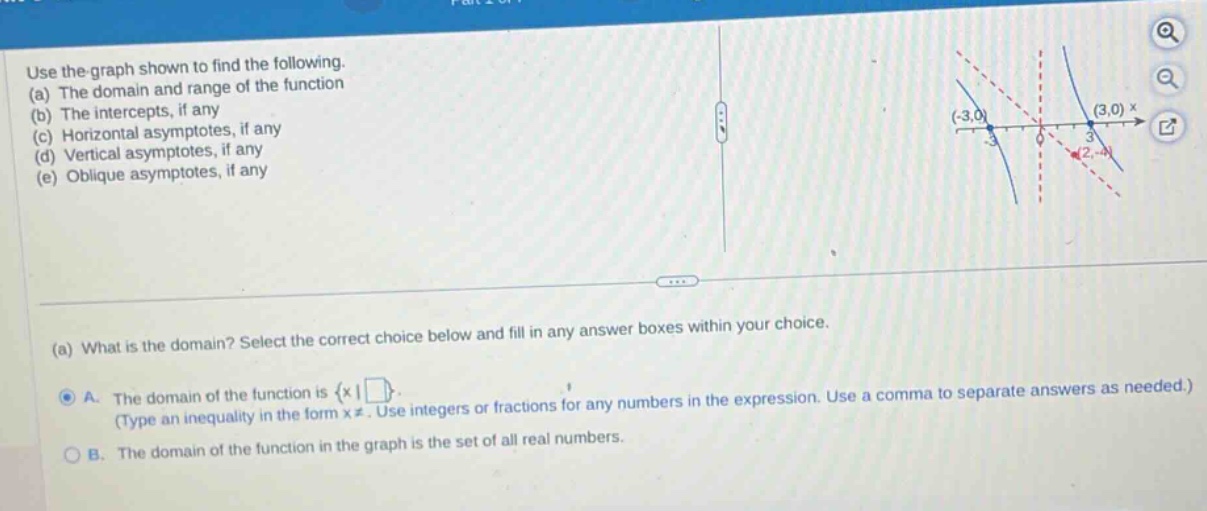
use the - graph shown to find the following. (a) the domain and range of the function (b) the intercepts, if any (c) horizontal asymptotes, if any (d) vertical asymptotes, if any (e) oblique asymptotes, if any (a) what is the domain? select the correct choice below and fill in any answer boxes within your choice. a. the domain of the function is {x| (type an inequality in the form x≠. use integers or fractions for any numbers in the expression. use a comma to separate answers as needed.) b. the domain of the function in the graph is the set of all real numbers.
Answer
Explanation:
Step1: Analyze domain from graph
The graph has a vertical asymptote at (x = 2). The domain of a rational - type function (judging from the asymptotes) excludes the values of (x) that make the denominator zero. Here, the function is not defined at (x = 2).
Step2: Write domain in inequality form
The domain is all real numbers except (x = 2), which can be written as (x\neq2).
Answer:
A. The domain of the function is ({x|x\neq2})