use the graph of y = e^x and transformations to sketch the exponential function f(x)=e^x + 8. determine the…
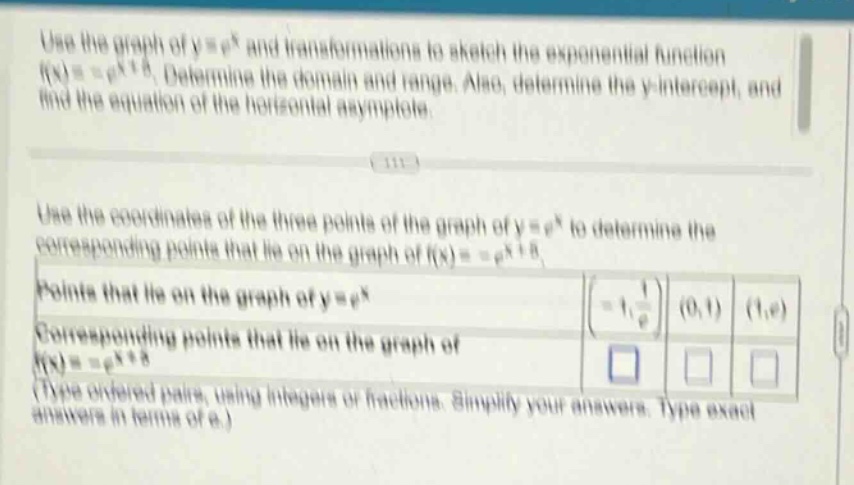
use the graph of y = e^x and transformations to sketch the exponential function f(x)=e^x + 8. determine the domain and range. also, determine the y - intercept, and find the equation of the horizontal asymptote. use the coordinates of the three points of the graph of y = e^x to determine the corresponding points that lie on the graph of f(x)=e^x + 8. points that lie on the graph of y = e^x (-1,1/e) (0,1) (1,e) corresponding points that lie on the graph of f(x)=e^x + 8 (type ordered pairs, using integers or fractions. simplify your answers. type exact answers in terms of e.)
Answer
Explanation:
Step1: Recall transformation rule
For $y = f(x + h)$, the graph of $y = f(x)$ is shifted left by $h$ units. Here $f(x)=e^{x}$ and $h = 8$, so $f(x)=e^{x+8}$.
Step2: Find corresponding points
If we have a point $(x,y)$ on $y = e^{x}$, for the function $y=e^{x + 8}$, when $x_1=x-8$, $y_1 = e^{x_1+8}=e^{x}$. For the point $(- 1,\frac{1}{e})$ on $y = e^{x}$: Let $x=-1$, for $y = e^{x+8}$, we set $x_1+8=-1$, then $x_1=-9$. So the corresponding point is $(-9,\frac{1}{e})$. For the point $(0,1)$ on $y = e^{x}$: Let $x = 0$, for $y = e^{x+8}$, we set $x_1+8=0$, then $x_1=-8$. So the corresponding point is $(-8,1)$. For the point $(1,e)$ on $y = e^{x}$: Let $x = 1$, for $y = e^{x+8}$, we set $x_1+8=1$, then $x_1=-7$. So the corresponding point is $(-7,e)$.
Step3: Domain
The domain of $y = e^{x+8}$ is all real - numbers since we can substitute any real number for $x$ into the function. In interval notation, the domain is $(-\infty,\infty)$.
Step4: Range
Since $e^{x+8}>0$ for all real $x$, the range of the function $y = e^{x+8}$ is $(0,\infty)$.
Step5: y - intercept
To find the $y$-intercept, set $x = 0$. Then $y=e^{0 + 8}=e^{8}$. So the $y$-intercept is $(0,e^{8})$.
Step6: Horizontal asymptote
As $x\to-\infty$, $e^{x+8}\to0$. So the equation of the horizontal asymptote is $y = 0$.
Answer:
Corresponding points: $(-9,\frac{1}{e})$, $(-8,1)$, $(-7,e)$ Domain: $(-\infty,\infty)$ Range: $(0,\infty)$ y - intercept: $(0,e^{8})$ Horizontal asymptote: $y = 0$