use the graph of y = e^x and transformations to sketch the exponential function f(x)= -e^(x - 6). determine…
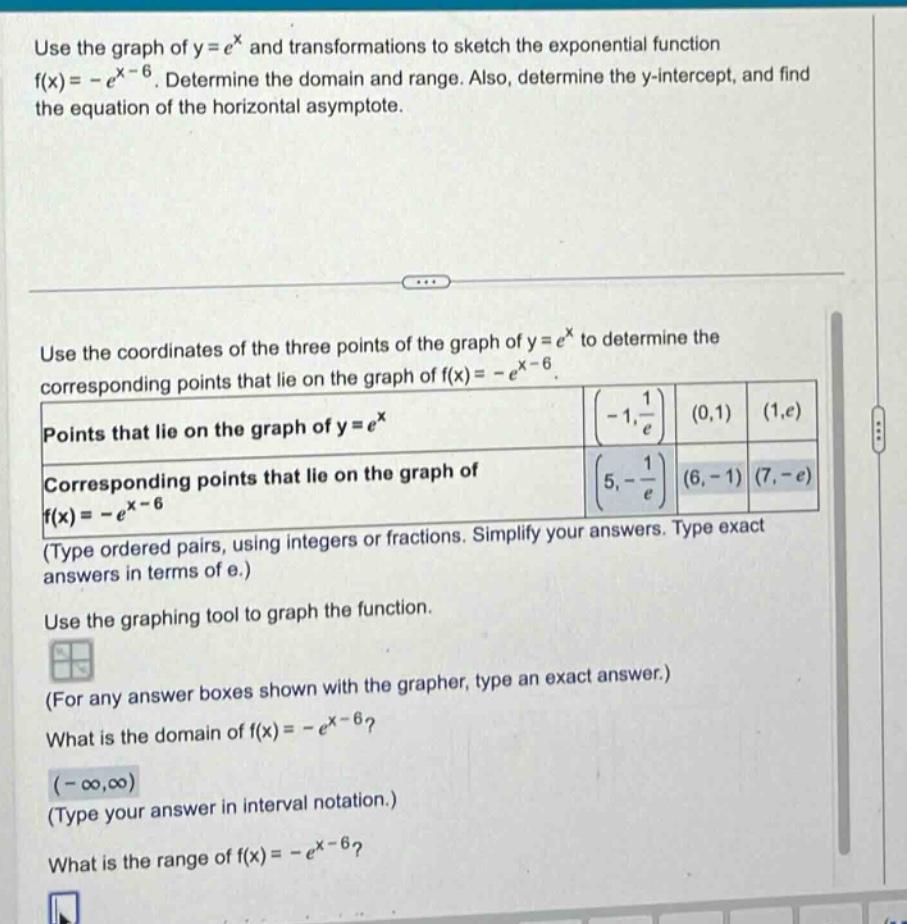
use the graph of y = e^x and transformations to sketch the exponential function f(x)= -e^(x - 6). determine the domain and range. also, determine the y - intercept, and find the equation of the horizontal asymptote. use the coordinates of the three points of the graph of y = e^x to determine the corresponding points that lie on the graph of f(x)= -e^(x - 6). points that lie on the graph of y = e^x (-1, 1/e) (0,1) (1,e) corresponding points that lie on the graph of f(x)= -e^(x - 6) (5, -1/e) (6, -1) (7, -e) (type ordered pairs, using integers or fractions. simplify your answers. type exact answers in terms of e.) use the graphing tool to graph the function. (for any answer boxes shown with the grapher, type an exact answer.) what is the domain of f(x)= -e^(x - 6)? (-∞,∞) (type your answer in interval notation.) what is the range of f(x)= -e^(x - 6)?
Answer
Explanation:
Step1: Analyze domain
For any exponential - type function of the form $y = a\cdot e^{bx + c}+d$, the domain is all real numbers since we can substitute any real - valued $x$ into the function. For $f(x)=-e^{x - 6}$, there are no restrictions on $x$. So the domain is $(-\infty,\infty)$.
Step2: Analyze range
The range of the basic exponential function $y = e^{x}$ is $(0,\infty)$. For the function $y = e^{x-6}$, the graph of $y = e^{x}$ is shifted 6 units to the right, and its range remains $(0,\infty)$. Then, for $f(x)=-e^{x - 6}$, we reflect the graph of $y = e^{x-6}$ about the $x$ - axis. So the range of $f(x)$ is $(-\infty,0)$.
Step3: Find y - intercept
The $y$ - intercept is found by setting $x = 0$. Substitute $x = 0$ into $f(x)=-e^{x - 6}$: [ \begin{align*} f(0)&=-e^{0 - 6}\ &=-e^{-6}\ &=-\frac{1}{e^{6}} \end{align*} ]
Step4: Find horizontal asymptote
As $x\to\infty$, $e^{x-6}\to\infty$, and $-e^{x - 6}\to-\infty$. As $x\to-\infty$, $e^{x-6}\to0$, so $y = 0$ is the horizontal asymptote of the function $f(x)=-e^{x - 6}$.
Answer:
Domain: $(-\infty,\infty)$ Range: $(-\infty,0)$ $y$ - intercept: $\left(0,-\frac{1}{e^{6}}\right)$ Horizontal asymptote: $y = 0$